

- The Context And The 8 PM Problem
- The Role Of Energy Storage
- The Verdict, Which Is Better
India can produce large amounts of affordable solar electricity during the day. The harder challenge is delivering that electricity when homes, offices, shops, cooling systems, and public infrastructure need it after sunset.
This is the 8 PM problem. Solving it will determine how much renewable energy the Indian grid can absorb without remaining heavily dependent on coal and gas.
The Context And The 8 PM Problem
Why Solar Creates The Duck Curve
Solar generation begins rising after sunrise, reaches its strongest level around midday, and falls rapidly during the evening. Electricity demand does not follow the same pattern, since consumption often remains strong between 6 PM and 8 PM.
This creates a deep fall in the electricity that must be supplied by conventional power plants during solar hours, followed by a sharp evening increase. When plotted across the day, this pattern resembles the shape of a duck, which is why it is called the duck curve.
The problem is not that India lacks electricity during the day. The problem is that a growing share of electricity is available several hours before consumers need it most.
Why The Evening Mismatch Matters
Without sufficient storage, some midday renewable electricity may be curtailed because the grid cannot use or transport all of it. A few hours later, coal plants, hydro stations, gas plants, or expensive market purchases must increase output quickly.
Globally, grids have used gas based Peaker plants to meet these short demand surges. India relies more heavily on flexible coal generation, hydro power, limited gas generation, and short term electricity purchases.
Peaker plants are expensive because they operate for relatively few hours while their capital and operating costs must still be recovered. They also increase fuel consumption, emissions, and exposure to coal and gas price volatility.
The Role Of Energy Storage
Grid scale storage acts as a time shifting system. It absorbs electricity when solar generation is abundant and releases that electricity during the evening peak.
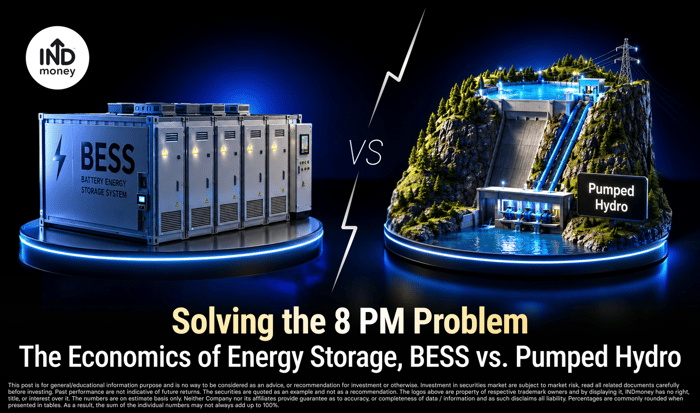
BESS stores electricity through batteries and power conversion equipment. Pumped hydro uses surplus electricity to move water from a lower reservoir to an upper reservoir, then releases the water through turbines when power is required.
Storage also supports frequency control, voltage stability, renewable integration, and lower curtailment. It can reduce pressure on transmission networks when installed near the point where electricity is generated or consumed.
However, a short duration battery does not convert solar into true 24 hour baseload power. It converts solar into a firmer and more dispatchable block of electricity for selected hours.
India already had around 2.93 GW of operational BESS power capacity and 8.66 GWh of energy capacity as of June 30, 2026. The CEA envisages 80 GW and 321 GWh of BESS alongside 94 GW and 567 GWh of pumped storage by 2035 to 2036, showing that India will require both technologies.
BESS Vs. Pumped Hydro
The correct comparison must examine more than the initial project cost. Duration, utilisation, financing, construction risk, efficiency, degradation, land, and transmission requirements can completely change the final economics.
| Factor | BESS | Pumped Hydro |
| Cost | CEA assumes ₹3.6 crore to ₹5 crore per MW for a 4 hour system. Lower cost for 2 to 4 hour storage, but degradation and replacement matter. | Around ₹5 crore to ₹6 crore per MW for a 6 hour system. Higher total project commitment, but very long life can lower lifetime cost. |
| Time | Usually 6 to 18 months. CEA planning assumes about 1 year of construction. | Construction can take about 3.5 to 4 years for an off stream closed loop project. Surveys, approvals, land, and DPR work can make the full cycle about 5 to 10 years. |
| Space | Compact and modular, although safety distances, cooling, and fire protection remain essential. | Requires reservoirs, tunnels, a powerhouse, water infrastructure, and considerably more land. |
| Location | Largely geography agnostic. It can be placed near substations, cities, industrial demand centres, or renewable projects. | Strictly dependent on elevation, geology, reservoir design, land availability, and access to water. |
Cost And Economics, CAPEX Is Not LCOS
Think of CAPEX as the sticker price, the upfront cash needed to build a project. LCOS (Levelized Cost of Storage) is the big picture, what the project actually costs to run over its entire lifetime, divided by every single unit of electricity it ever delivers.
Let's look at big battery farms (BESS) designed to run for 4 hours. Building them costs roughly ₹3.6 crore to ₹5 crore per Megawatt (MW). If we break that down by actual storage capacity, you are paying about ₹0.90 crore to ₹1.25 crore for every Megawatt-hour (MWh) of juice.
Now compare that to a 6-hour pumped hydro project. The total build cost is a bit higher - ₹5 crore to ₹6 crore per MW. But because it holds more energy for longer, the math shifts. The cost per capacity drops to ₹0.83 crore to ₹1 crore per MWh. So, purely based on storage size, pumped hydro is actually cheaper upfront than batteries.
But battery prices are falling off a cliff. In just the last couple of years, the cost to store energy in grid batteries plummeted from over ₹10 per unit (kWh) down to about ₹2.8 per unit (assuming a realistic usage of one and a half charging cycles a day).
Of course, storing power isn't free, you have to buy the electricity to charge the system up. If solar power costs ₹2.5 per unit, you have to account for the fact that batteries lose a little bit of energy in the process (they are about 88% efficient). Add that slight loss to the ₹2.8 storage cost, and the final price of the power you get back is roughly ₹5.64 per unit, before transmission fees.
Pumped hydro is a little clunkier when it comes to efficiency, holding onto about 80% of the energy. But its superpower is time. While financial models price these projects on a 40-year timeline, the physical dams and reservoirs can easily stand for a century, needing little more than some new machinery halfway through.
Batteries just don't have that kind of stamina. A typical system lasts about 15 years, losing roughly 2.5% of its capacity every single year. Eventually, those battery packs have to be replaced or topped up. Meanwhile, a massive pumped hydro reservoir will just keep moving water up and down the hill for generations.
Time, Speed Has Economic Value
BESS is manufactured in modules, transported to the site, connected to the grid, and commissioned. This makes it suitable when a DISCOM or grid operator needs evening capacity within the next few demand seasons.
Pumped hydro requires topographical surveys, geological investigations, environmental approvals, land acquisition, reservoir construction, tunnelling, and major electrical equipment. CEA guidelines allow around 690 to 840 days for DPR preparation alone, while the latest roadmap estimates around 3.5 to 4 years of construction for an off stream closed loop project.
The delay has a financial cost. Interest continues accumulating during construction, while geological surprises, approval delays, and cost overruns can weaken project returns.
Space And Location, Flexibility Vs. Scale
BESS can be built on relatively compact sites and expanded in stages. A utility can install it beside a congested substation, close to a city, or alongside a solar project.
This flexibility can reduce transmission congestion and defer network investment. However, BESS is not infrastructure agnostic, since grid connectivity, cooling, fire safety, and access remain important.
Pumped hydro needs a suitable elevation difference between 2 reservoirs, strong geology, land, and sufficient water for the initial fill and operating losses. CRrelosed loop projects can reduce river impact, but they cannot remove the basic dependence on terrain.
A pumped hydro site may be far from the demand centre or renewable project. Additional transmission lines can then increase the effective project cost and development time.
The Verdict, Which Is Better
For a new project designed specifically to shift midday solar into a 2 to 4 hour evening window, BESS is the undisputed practical winner. It is faster to deploy, easier to locate near demand, modular, and increasingly cost effective for short duration use.
Pumped hydro remains the reigning champion for bulk and long duration storage. Its ability to discharge for 6 hours or more, provide physical grid inertia, and operate for several decades makes it better suited to system wide stability and, where reservoirs are sized accordingly, multi day resilience.
India therefore does not face a choice between batteries and water. BESS can solve the urgent 8 PM problem, while pumped hydro can provide the deeper storage foundation required as renewable energy becomes the dominant part of the electricity system.