

- Why Investors Suddenly Started Watching Apollo
- Apollo Is No Longer Just A Defence Electronics Supplier
- Why This Business Is Becoming Important
- Apollo Is Expanding Beyond Electronics
- The IDL Explosives Acquisition Could Change The Business
- Why Margins Are Improving
- Why Defence Is Becoming A Massive Opportunity
- Things Investors Should Watch
- Final Thoughts
Apollo Micro Systems shares surged more than 10% today, extending the stock’s massive rally over the past few months. The sharp move reflects growing investor excitement around one big theme: India’s defence manufacturing transformation.
For years, India depended heavily on imported defence systems and foreign technology. But now, the country is trying to build more of its defence capability at home.
And while most people focus on missiles, drones, and rockets, the real opportunity may lie deeper inside these systems. Because modern weapons are no longer just metal and explosives.
They are powered by electronics, sensors, onboard computers, navigation systems, and targeting technology. That’s where companies like Apollo Micro Systems come in.
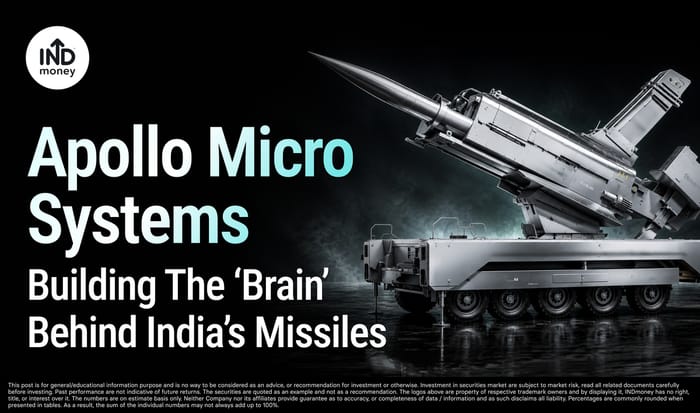
India may build the missile, but companies like Apollo build its nervous system.
Why Investors Suddenly Started Watching Apollo
Apollo Micro Systems has become one of the biggest defence stock stories in recent months. The reason is not just defence sector excitement. The company’s business performance itself has improved sharply.
Q4 FY26 Performance
| Metric | Performance |
|---|---|
| Revenue | ₹293 crore (+81% YoY) |
| EBITDA | ₹67.6 crore (+88% YoY) |
| PAT | ₹36.8 crore (+164% YoY) |
| PAT Margin | 13% |
More importantly, profit growth is happening faster than revenue growth. That usually tells investors one thing: the business is becoming more efficient as it scales. The full-year FY26 numbers were also strong.
FY26 Performance
| Metric | Performance |
|---|---|
| Revenue | ₹904 crore (+61% YoY) |
| EBITDA | ₹218 crore (+69% YoY) |
| PAT | ₹107 crore (+91% YoY) |
| EBITDA Margin | 24% |
| Order Book | ₹1,432 crore |
This is the kind of combination markets usually reward:
- fast growth
- improving profitability
- rising order visibility
- expanding margins
And that is one of the biggest reasons the stock has seen such a sharp re-rating.
Apollo Is No Longer Just A Defence Electronics Supplier
The biggest shift happening inside Apollo is business transformation. The company is trying to move from being a defence electronics supplier to becoming a full-stack defence manufacturing company.
That is a much bigger opportunity. Think of a missile like a human body.
- The engine gives it movement
- The warhead gives it firepower
- But the electronics act like the brain and nervous system
These systems help missiles:
- track targets
- navigate accurately
- communicate
- make corrections mid-flight
- strike precisely
Without these systems, modern missiles become far less effective. This is where Apollo operates. And this layer is becoming increasingly important in modern warfare.
Why This Business Is Becoming Important
Most investors focus on companies that manufacture visible defence equipment. But modern warfare is increasingly becoming technology-driven.
Today’s missiles and weapon systems rely heavily on precision targeting, navigation systems, sensors, onboard computing, and communication technology. In simple words, the intelligence inside the weapon is becoming just as important as the weapon itself.
That creates a large opportunity for companies working in defence electronics and integrated systems.
Apollo already has participation across several indigenous missile and defence programs like Akash, BrahMos NG, Pralay, and Pinaka. This is important because India is increasingly pushing toward local defence manufacturing and reducing dependence on imports.
As more indigenous missile programs move toward larger production and deployment, companies already embedded inside these ecosystems could benefit for years.
Apollo Is Expanding Beyond Electronics
Apollo’s ambitions now go far beyond defence electronics. The company is expanding into areas like underwater mines, torpedoes, aerial bombs, rockets, drones, explosives, and weapon integration.
This significantly increases the size of the opportunity for the company. Instead of supplying only individual electronic components, Apollo now wants to participate across larger parts of the defence manufacturing value chain.
That is a very different business model compared to a traditional defence electronics supplier and could help the company play a much bigger role in India’s growing indigenous defence ecosystem.
The IDL Explosives Acquisition Could Change The Business
One of Apollo’s biggest strategic moves was the acquisition of IDL Explosives through its subsidiary. This gives the company:
- explosive manufacturing capability
- backward integration
- access to industrial and defence explosives
- larger manufacturing scale
This matters because defence manufacturing is heavily dependent on supply chain control. By expanding into explosives, Apollo is trying to strengthen its position across the entire defence manufacturing ecosystem.
The company also highlighted that IDL recently secured a major Coal India order worth around ₹421 crore after operational restrictions were removed.
That gives the explosives business a stable revenue base while Apollo expands deeper into defence manufacturing.
Why Margins Are Improving
One of the most important things investors are tracking in Apollo Micro Systems is margin expansion.
And the improvement over the last year has been quite visible. On a consolidated basis:
- EBITDA margin improved from 22% in FY25 to 24% in FY26
- PAT margin improved from 10% to 12%
Even at the quarterly level, profitability continued to strengthen:
- Q4 FY26 EBITDA margin stood at 23%
- Q4 FY26 PAT margin improved to 13%
A big reason behind this could be Apollo’s gradual shift toward higher-value defence systems, larger project execution, and expansion beyond components into more integrated defence offerings.
If the company continues moving higher up the defence value chain, margins could improve further over time.
Why Defence Is Becoming A Massive Opportunity
India’s defence sector is entering a long-term growth phase.
In the Union Budget 2025-26, India allocated nearly ₹6.8 lakh crore toward defence spending, making it one of the country’s largest budget allocations. A significant part of this is now being directed toward indigenous manufacturing and domestic procurement.
The government is also steadily reducing import dependence through initiatives like Atmanirbhar Bharat and higher focus on locally developed defence systems.
This creates a large opportunity for Indian defence companies that already have:
- technological capability
- manufacturing infrastructure
- long-standing defence relationships
Apollo Micro Systems appears to be positioning itself directly within this broader indigenization trend.
Things Investors Should Watch
Despite the strong excitement, investors should also remember that defence businesses come with risks. Some key things to watch include:
- execution delays
- long project cycles
- dependence on government orders
- defence procurement delays
- high expectations after the recent stock rally
Defence manufacturing is a long-cycle business, and growth may not always move in a straight line. That makes execution extremely important.
Final Thoughts
India’s defence story is no longer just about importing weapons. It is increasingly about building strategic capability inside the country.
And in modern warfare, electronics have become just as important as firepower. Missiles today need intelligence, navigation, communication, and precision systems to operate effectively.
That intelligence layer is where companies like Apollo Micro Systems operate. The missile may carry the warhead. But the electronics decide whether it reaches the target.
And India’s next defence giants may not always be the companies building the missile shell. They may be the companies building the intelligence inside it.