

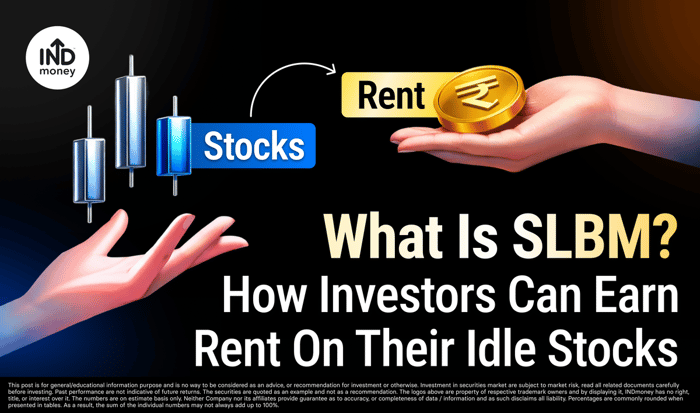
- What is SLBM?
- What do you need before starting SLBM?
- Which stocks can you lend?
- How does SLBM work step by step?
- Why do traders borrow your shares?
- How much can you actually earn?
- Are there minimum limits in SLBM?
- How do you place an SLBM order?
- What are the real risks in SLBM?
- How is SLBM income taxed?
- Who should use SLBM?
- Final Word
You can earn extra income from your stocks without selling them through SLBM. It works like renting out your shares and earning a fee. But this income is not fixed, and your shares may get locked during the lending period.
Most investors don’t realize this. Their stocks sit idle for years with no extra income. SLBM changes that. In this blog, we will understand how it works, how to start, what you earn, and the real risks involved.
What is SLBM?
SLBM stands for Securities Lending and Borrowing Mechanism. It is regulated by the Securities and Exchange Board of India.
It allows you to lend your shares to traders for a fixed period (tenure ranging from 1 month to 12 months) and earn a fee.
Think of it like this: You own shares. A trader borrows them. They pay you “rent” for using them.
What do you need before starting SLBM?
You cannot start instantly. There are a few basic requirements.
1. DDPI activation: DDPI means Demat Debit and Pledge Instruction. It allows your broker to move shares from your account when required. This is usually activated online using Aadhaar OTP.
2. SLB segment activation: You must enable the SLB segment in your trading account. This usually takes up to 48 hours after the request.
3. Broker support: Not all brokers offer SLBM. So first check with your broker, if your broker supports it.
Which stocks can you lend?
Not all stocks are allowed. Eligible stocks are usually:
- F&O stocks
- Highly traded ETFs
- Stocks with good liquidity
You can check live demand on the exchange.
Platforms like the National Stock Exchange of India show which stocks are in demand and what fees borrowers are willing to pay.
This is important. No demand means no income.
How does SLBM work step by step?
The system runs through exchanges like the BSE and NSE.
Here is the simplified flow:
Step 1: You place a lending request: You choose stock, quantity, time period, and fee.
Step 2: Borrower places request: A trader agrees to borrow at a certain price.
Step 3: Order matching: Exchange matches both sides.
Step 4: Shares move safely: Shares go to the clearing system and then to the borrower.
Step 5: Collateral is maintained: Borrower deposits around 125% of the stock value as safety.
Step 6: Expiry and return: You receive the lending fee immediately when the contract starts. Contracts expire on the first Tuesday of the month, and your shares safely return to your account on the first Thursday.
Why do traders borrow your shares?
Borrowers are usually active traders.
They use your shares mainly for:
- Short selling
- Arbitrage
For example:
A trader thinks SBI at ₹900 will fall. He/she borrow from you and sell at ₹900. If the price falls to ₹850, he buy back and return shares.
His profit = ₹50 per share (minus costs). Your income = lending fee.
How much can you actually earn?
This is the most important part. Let’s break it down in the simplest way.
Example:
- You lend 1,000 shares
- Stock price = ₹900
- Lending fee = ₹10 per share
Your total income: 1,000 × ₹10 = ₹10,000
Now charges:
- Broker fee = 20% of ₹10,000 = ₹2,000
- GST (18% on ₹2,000) = ₹360
Final earnings:
₹10,000 − ₹2,000 − ₹360 = ₹7,640
Important point: Broker charges apply only to the fee, not to the ₹9 lakh stock value.
Are there minimum limits in SLBM?
There is a lot of confusion here. There is no fixed ₹1 lakh or 500 shares rule from the exchange.
Limits depend on:
- Broker
- Stock
- Liquidity
Some brokers allow small quantities. Others may impose higher limits. Always check your broker platform.
How do you place an SLBM order?
This is not like a normal buy or sell order.
In many cases, you need to place it manually.
General process:
- Go to your broker’s support or ticket section
- Select SLB order request
- Enter stock name, quantity, fee, and expiry
- Submit request during market hours (10 AM to 5 PM)
Your broker places the order on your behalf.
If matched, your shares get lent.
What are the real risks in SLBM?
SLBM is backed by clearing corporations like NSE Clearing Limited. But risks still exist.
1. Lock-in risk: You cannot sell shares during lending. And if market falls, you may get stuck.
2. Hidden tax risk: If the borrower defaults, shares are auctioned. This is treated as a sale. You may pay capital gains tax.
3. Early foreclosure: Corporate actions can end the contract early.
SLBM has two types of contracts:
- Series A: Closed early if any major event happens
- Series B: Not closed for AGM or EGM, but still closed for major events
Major events include:
- Bonus
- Buyback
- Merger
- Open offer
If this happens, your shares come back early. But you will have to return part of the fee for the remaining period.
4. No demand risk: You earn only if someone borrows your shares. If there is no demand, you earn nothing.
How is SLBM income taxed?
Normal SLBM does not trigger capital gains tax. Because shares are not sold. But your earnings are taxable.
It is treated as:
- Income from Other Sources, or
- Business Income
Tax depends on your slab.
Who should use SLBM?
SLBM is useful only in specific cases.
Suitable for:
- Long-term investors
- Low trading activity
- Comfortable with temporary lock-in
Not suitable for:
- Traders needing liquidity
- Investors expecting stable income
Reality check: Even though some cases show 6% to 12% annual returns, most investors earn little or nothing due to low demand.
Final Word
SLBM is a smart add-on, not a core strategy. It can generate extra income from idle stocks, but only when demand exists. The biggest trade-off is losing flexibility during market moves. Use it selectively, not blindly.
Disclaimer
Source: SEBI guidelines, NSE Clearing Limited, NSE, and BSE SLBM framework. Investments in the securities market are subject to market risks. Read all the related documents carefully before investing. The securities are quoted as an example and not as a recommendation. This is nowhere to be considered as advice, recommendation, or solicitation of an offer to buy or sell or subscribe for securities. INDStocks SIP / Mini Save is a SIP feature that enables Customer(s) to save a fixed amount on a daily basis to invest in Indian stocks. INDstocks Private Limited (formerly known as INDmoney Private Limited) 616, Level 6, Suncity Success Tower, Sector 65, Gurugram, 122005, SEBI Stock Broking Registration No: INZ000305337, Trading and Clearing Member of NSE (90267, M70042) and BSE, BSE StarMF (6779), SEBI Depository Participant Reg. No. IN-DP-690-2022, Depository Participant ID: CDSL 12095500, Research Analyst Registration No. INH000018948 BSE RA Enlistment No. 6428. Refer to https://indstocks.com/pricing?type=indian-stocks; https://www.indstocks.com/page/indian-stocks-sip-terms-and-condition for further details.