

- What Is EPFO 3.0?
- Key Features Of EPFO 3.0
- Why UPI And ATM Withdrawals Are Important
- What Is The Auto-Settlement Upgrade?
- Why EPFO 3.0 Is Bigger Than Convenience
- The Core Banking-Style System Is The Real Upgrade
- What EPFO 3.0 Means For Employees
- What It Means For India’s Financial System
- What Investors And Policy Watchers Should Track
- Author’s Take
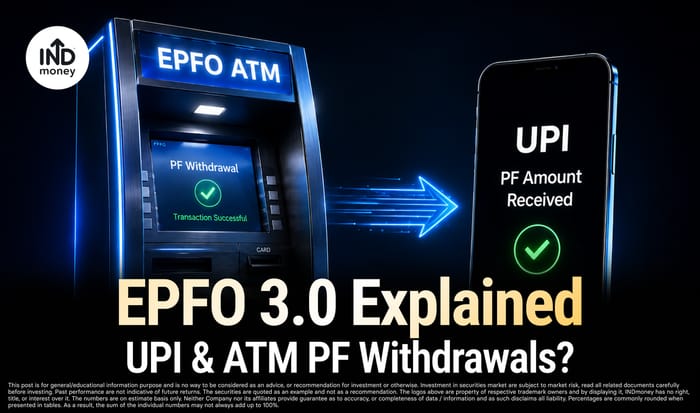
EPFO 3.0 is being discussed mainly because of one headline feature: PF withdrawals through UPI and ATM. But the real story is bigger.
EPFO is not just another government platform. It manages retirement savings for crores of salaried employees in India. So, when EPFO becomes faster, more digital and easier to use, it directly impacts how millions of people access and manage their provident fund money.
EPFO 3.0 is an attempt to move one of India’s largest social security systems from a paperwork-heavy process to a banking-style digital platform.
What Is EPFO 3.0?
Before understanding EPFO 3.0, it helps to understand EPF.
The Employees’ Provident Fund, or EPF, is a retirement savings scheme for salaried employees in India. Every month, both the employee and employer contribute a portion of the employee’s salary into the EPF account. These contributions earn interest over time and help build a retirement corpus.
The Employees’ Provident Fund Organisation, or EPFO, is the government body that manages these accounts. It handles services such as PF withdrawals, account transfers, claim processing and account maintenance.
EPFO currently manages retirement savings for crores of salaried workers across India, making it one of the country’s largest social security systems.
EPFO 3.0 is a major digital upgrade of this system. The goal is to make PF services faster, easier and more self-service driven.
Today, many EPFO services still depend on forms, approvals, claim processing and waiting periods. EPFO 3.0 aims to reduce this friction by using digital tools, Aadhaar-linked verification, UPI, mobile access and a core banking-style system.
In simple words, EPFO wants to make managing a PF account feel closer to how people use banking and payment apps today.
Key Features Of EPFO 3.0
| Feature | What It Means |
| UPI-based PF withdrawal | Eligible PF withdrawals may be transferred through UPI-linked bank accounts |
| ATM withdrawal facility | Members may be able to access PF funds through ATM-style channels |
| Higher auto-settlement limit | Auto-settlement limit has been increased from ₹1 lakh to ₹5 lakh |
| Self-correction of details | Members can update many personal details digitally |
| Aadhaar-based PF transfer | PF transfers can become less dependent on employer approval if KYC is complete |
| Mobile app access | Members can manage PF services directly from their phones |
| Core banking-style system | EPFO will move towards a centralized digital architecture |
| Paperless processing | Manual paperwork and delays can reduce over time |
Why UPI And ATM Withdrawals Are Important
The biggest visible change under EPFO 3.0 is easier PF withdrawal. Today, if a member wants to withdraw PF, the process usually involves submitting a claim, waiting for verification and then receiving money in the bank account.
With UPI and ATM-based withdrawal access, this process can become much faster for eligible claims. But what does “eligible withdrawal” actually mean?
It is important to note that EPFO 3.0 does not allow unrestricted PF withdrawals. Members can still withdraw PF only under existing EPFO rules.
These rules allow withdrawals in specific situations such as retirement, unemployment after a specified period, medical emergencies, higher education, marriage, home purchase, home loan repayment and other approved circumstances.
So, EPFO 3.0 is not changing the basic withdrawal rules. It is changing the mode and speed of access. That is an important distinction.
The member still needs to be eligible under EPFO rules. But once the claim is eligible, the withdrawal process may become faster through UPI and ATM-linked access.
This matters because many salaried employees use PF advances during emergencies. If the system becomes faster, members can access their eligible PF funds more quickly when they need them.
At the same time, PF remains a retirement savings product. Easier access should not encourage unnecessary withdrawals that could reduce long-term retirement savings.
What Is The Auto-Settlement Upgrade?
One of the most important changes under EPFO 3.0 is the increase in the auto-settlement limit. When a member submits a PF advance claim, EPFO normally verifies the request before releasing the money.
Some claims, however, can be processed automatically without extensive manual review. This process is known as auto-settlement.
Earlier, eligible claims up to ₹1 lakh could be processed through this automated route. The limit has now been increased to ₹5 lakh.
This means a much larger number of eligible claims can potentially be processed without significant manual intervention.
For employees, this can reduce waiting time during medical emergencies, education expenses, marriage-related needs and certain housing-related requirements.
For EPFO, it reduces administrative workload. For the overall system, it represents a shift from manual processing towards faster digital claim settlement.
Why EPFO 3.0 Is Bigger Than Convenience
At first, EPFO 3.0 may look like a simple user-experience upgrade. But the deeper story is about India’s financial infrastructure.
India has already seen how digital public infrastructure can change user behaviour. UPI changed payments. Aadhaar changed identity verification. Core banking changed how banks operate. EPFO 3.0 could do something similar for retirement savings. The shift is clear.
- EPFO is moving from paperwork to digital claims.
- From long waiting periods to faster settlement.
- From employer dependency to more self-service.
- From record-keeping to real-time account access.
- That is why this upgrade matters beyond just PF withdrawals.
The Core Banking-Style System Is The Real Upgrade
Most people are focusing on ATM withdrawals. But the more important change is EPFO’s move towards a core banking-style architecture.
In banking, core banking allows customers to access accounts, transactions and services across branches and digital channels in a centralized way.
If EPFO builds a similar structure, it can make the entire PF system more efficient.
It can help with faster account updates, better grievance handling, smoother PF transfers, centralized member servicing and stronger integration with banks and payment systems.
This is the part that can have long-term impact. The real value of EPFO 3.0 is not only that money can be withdrawn faster. The bigger value is that the whole PF system can become easier to manage across an employee’s working life.
What EPFO 3.0 Means For Employees
For employees, EPFO 3.0 can make PF easier to track, manage and withdraw. A member may not need to depend as much on physical forms or employer follow-ups for every small update.
Services like claim settlement, KYC-linked transfer, personal detail correction and account access can become more digital. This can reduce frustration for salaried workers, especially those who change jobs frequently.
PF transfer after job change has historically been a pain point for many employees. If Aadhaar-linked digital transfers become smoother, EPFO 3.0 can solve a major user problem.
But employees should also remember that PF is meant to build long-term retirement security. Faster access is useful during genuine need, but frequent withdrawals can reduce the power of compounding over time.
What It Means For India’s Financial System
EPFO manages one of India’s largest pools of retirement savings. So, improving EPFO is not just an employee-benefit reform. It is also a financial system upgrade.
If EPFO becomes more transparent, faster and easier to use, it can improve trust in formal retirement savings.
This is important because India is still building deeper financial participation. Many people use bank accounts and UPI actively, but long-term savings products often feel complex or difficult to access.
A better EPFO experience can help bridge that gap. It can make formal retirement savings feel more user-friendly.
What Investors And Policy Watchers Should Track
- The first thing to watch is the actual rollout timeline.
- The second thing is whether UPI and ATM withdrawal features work smoothly at scale.
- The third thing is adoption. A digital feature matters only if members actually use it.
- The fourth thing is claim settlement speed. If processing time falls meaningfully, EPFO 3.0 will be seen as a real upgrade.
- The fifth thing is integration with banks, UPI apps and mobile platforms.
- And finally, watch whether this improves trust in formal retirement savings.
Author’s Take
EPFO 3.0 should not be seen only as a PF withdrawal upgrade. The bigger story is that India is modernizing one of its most important retirement savings systems.
For salaried employees, it can mean faster access, easier account management and less paperwork. For the government, it can mean a more scalable social security platform.
For India’s financial system, it can improve trust in formal savings and push retirement infrastructure closer to the digital experience people already get from banks and UPI apps.
But the real test will be execution. If EPFO 3.0 delivers smooth rollout, strong cybersecurity, faster claim settlement and responsible withdrawal access, it can become one of the most important digital upgrades for India’s salaried workforce.