

- First, What Are Passive Funds, ETFs and Thematic Funds?
- Passive Investing Is No Longer Just About Nifty 50 and Sensex
- July 2026 Shows How Specific Passive Investing Has Become
- Passive Investing Is Also Moving Beyond Sectors
- So How Is This Different From Directly Buying Stocks?
- The Fund Is Passive, But the Investor's Decision Is Still Active
- What Does an Investor Gain by Buying the Basket?
- But Buying the Basket Does Not Make the Sector Safe
- Which Type of Passive Fund Makes Sense for You?
- Are Passive Funds Becoming the New Thematic Funds?
- Conclusion: Choose the Theme, Let the Index Choose the Stocks
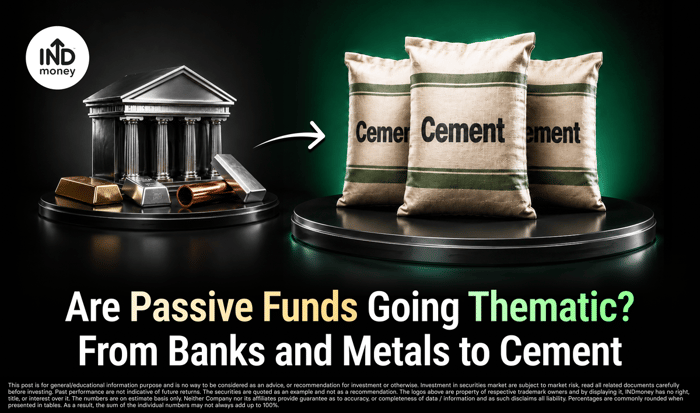
Want to invest in cement? You don't necessarily have to pick a cement stock. Suppose an investor believes India's infrastructure and housing growth could benefit cement companies. Traditionally, the next question would be: which cement stock should I buy? The investor would then have to compare companies based on capacity, margins, debt, valuations, market share and future growth before deciding where to invest.
But there is increasingly another route. In July 2026, Groww launched the Nifty Cements ETF. During the same month, mutual fund houses also launched passive products focused on metals, banks, private banks, automobiles and insurance. This means an investor can take a view on a particular sector without necessarily having to identify which individual company within that sector will perform the best.
This marks an important change in how passive investing can be used. Passive investing is no longer limited to broad indices such as the Nifty 50 or Sensex. Investors can increasingly use passive funds to get exposure to specific sectors, themes and investment strategies without directly buying and managing individual stocks.
First, What Are Passive Funds, ETFs and Thematic Funds?
Before understanding this change, it helps to know what these terms actually mean.
A passive fund is a fund that tries to replicate an index instead of relying on a fund manager to actively select stocks with the aim of beating the market. For example, a Nifty 50 index fund invests in companies represented in the Nifty 50 according to the rules and weightings of that index. When the index changes, the fund adjusts its portfolio accordingly.
Passive investing is commonly available through index funds and Exchange Traded Funds, or ETFs. An index fund works like a regular mutual fund, where investors can invest directly through the fund house and can also use SIPs. An ETF also tracks an underlying index, but its units are bought and sold on the stock exchange during market hours, similar to shares.
A thematic or sectoral fund, on the other hand, tells you where the money is being invested. Instead of investing across the broader market, such a fund focuses on a particular area such as banking, technology, infrastructure, healthcare or manufacturing. Many thematic mutual funds are actively managed, meaning a fund manager decides which companies within the theme should be held and how much should be invested in each.
This is where the newer passive products become interesting. An investor can now get similar focused exposure through an index fund or ETF. A metal ETF can track a basket of metal companies, while a banking ETF can track a basket of banking stocks.
So passive and thematic are not necessarily opposites. Passive tells us how the portfolio is managed, while sectoral or thematic tells us where the money is invested.
| Type of Investment | What Does It Provide? | Who Largely Decides the Stocks? |
| Broad-market index fund | Exposure to a broad index such as Nifty 50 | Index rules |
| Sector or strategy-based passive fund | Exposure to banks, metals, momentum, etc. | Index rules |
| Active thematic fund | Exposure to a particular sector or theme | Fund manager |
| Direct stocks | Exposure to individually selected companies | Investor |
This distinction is important because investors now have another route between simply buying the overall market and selecting individual stocks themselves.
Passive Investing Is No Longer Just About Nifty 50 and Sensex
Now that the distinction is clear, look at how the passive fund market itself is changing. The first wave of passive investing was largely associated with broad indices such as the Nifty 50 and Sensex. The idea was simple: instead of trying to identify which stocks would outperform, investors could buy a basket representing a broad part of the market.
That option still exists, but the passive universe has become much wider. Today, indices can represent individual sectors, different market-cap segments and even investment strategies such as momentum, equal weighting and dividend investing.
As a result, passive investing can now serve very different purposes. One investor may simply want to participate in the broader equity market. Another may already have a view on banking, metals, automobiles or another area and want additional exposure to that particular part of the market.
Both may be using passive funds, but the investment decision behind them is very different.
July 2026 Shows How Specific Passive Investing Has Become
AMFI's July 2026 data provides a good example of this shift. During the month, 25 new mutual fund schemes completed their allotment. Of these, five were index funds and 11 were ETFs. This means 16 of the 25 new launches, or 64%, were passive products.
But the number of launches is not the most interesting part. What stands out is what many of these products were designed to track.
| Investor Wants Exposure To | Passive Products Launched in July 2026 |
| Metals | Edelweiss Nifty Metal ETF, HDFC Nifty Metal ETF |
| Banks | Bajaj Finserv BSE Top 10 Banks ETF, Edelweiss BSE Top 10 Bank ETF |
| Private Banks | Kotak Nifty Private Bank ETF |
| Auto | HDFC Nifty Auto Index Fund |
| Insurance | ICICI Prudential BSE Insurance ETF |
| Cement | Groww Nifty Cements ETF |
| Momentum | Motilal Oswal BSE Midcap 150 Momentum 30 Index Fund, Mirae Asset BSE Midcap 150 Momentum 30 ETF |
| Equal Weight | Axis Nifty50 Equal Weight Index Fund |
| Dividend Strategy | Edelweiss BSE LargeMid (60:40) Stable Dividend 50 ETF |
Source: AMFI July 2026 Monthly Report.
Just in one month, investors got new passive options around metals, banks, private banks, automobiles, insurance and cement. This shows that passive investing is increasingly becoming a way to target specific parts of the market, rather than simply buying the overall market.
But the shift does not stop with sectors.
Passive Investing Is Also Moving Beyond Sectors
Some of July's new passive products were not based on industries at all. They were built around strategies such as momentum, equal weighting and dividends.
Take momentum as an example. An investor interested in momentum investing would otherwise have to identify stocks showing strong price trends, decide how much to allocate to each one and periodically rebalance the portfolio. A momentum index does this using predefined rules, and an index fund or ETF can then track that basket.
An equal-weight index works differently from a traditional market-cap weighted index. Instead of automatically giving the biggest companies the largest weights based on their market value, it gives constituents equal or similar weights according to the index methodology. Dividend-based indices can similarly select stocks based on predefined dividend-related rules.
This means the passive universe is expanding from the question of "Which sector do I want?" to "Which investment strategy do I want?" The investor chooses the idea, while the index rules determine how the basket is constructed.
So far, this explains how the passive fund market is changing. But for an investor, the more practical question is: how is buying one of these funds different from simply buying the stocks directly?
So How Is This Different From Directly Buying Stocks?
Suppose an investor believes the banking sector could perform well over the next few years. One option is to directly buy banking stocks. But that immediately creates another set of decisions. Should the investor buy HDFC Bank, ICICI Bank, SBI or Axis Bank? Should the money be spread across several banks? How much should be invested in each company, and when should those holdings be changed?
A banking index fund or ETF provides another route. Instead of trying to identify which bank will outperform, the investor can buy a basket of banking companies selected according to the rules of an underlying index.
The decision therefore changes from "Which bank stock should I buy?" to "Do I want additional exposure to the banking sector?"
The same idea applies elsewhere. Someone positive on cement does not necessarily have to decide which cement company will be the biggest winner. An investor expecting metals to benefit from a favourable cycle does not necessarily have to select between individual metal stocks.
This is one of the biggest practical uses of these products. You can choose the sector or strategy without necessarily having to choose the individual stocks.
However, making the investment easier to execute does not mean the investor has stopped making active decisions altogether.
The Fund Is Passive, But the Investor's Decision Is Still Active
Suppose an investor buys a metal ETF. The fund manager is generally not actively deciding whether Tata Steel, Hindalco or another metal company looks more attractive at a particular point in time. The fund largely follows the composition and rules of its underlying index.
So the fund is being managed passively. But the investor has still made an active decision by choosing to give metals additional exposure in the portfolio.
The same applies to banking, cement, automobiles, insurance or momentum. The investor may not be selecting each individual stock, but the investor is still deciding which part of the market deserves additional money.
A simple way to remember this is: a sector-based passive fund can remove the need to pick individual stocks, but it does not remove the need to pick the right sector or strategy.
That distinction also helps explain why buying a basket can be useful.
What Does an Investor Gain by Buying the Basket?
One advantage is that the investment becomes less dependent on one company's performance. Suppose an investor buys only one cement stock and that company later faces a business-specific problem. The investment could suffer even if the broader cement industry performs reasonably well. A cement index spreads the exposure across multiple eligible companies instead of relying completely on one stock.
This can reduce single-company risk. It does not mean the investment becomes risk-free, but one wrong company decision is less likely to determine the entire outcome.
There can also be less company-specific research involved. An investor does not necessarily have to compare every company's debt, margins, valuations, capacity expansion and earnings outlook before deciding which stocks should be held. The index follows predefined rules for selecting and weighting companies.
Another benefit is periodic rebalancing. If a company enters or exits the index or its weight changes, the fund adjusts its portfolio accordingly. An investor trying to build the same basket manually would need to monitor these changes and buy or sell stocks individually.
Most importantly, an investment idea becomes easier to execute. An investor can effectively say, "I want exposure to banking" rather than saying, "I want exposure to banking, so now I need to research 10 banks and decide which two or three to buy."
However, reducing the need to select individual companies should not be confused with removing investment risk.
But Buying the Basket Does Not Make the Sector Safe
Buying several stocks from one sector is not the same as being broadly diversified.
A metal ETF may hold multiple metal companies, but most of those businesses can still be affected by the same factors, including commodity prices, global demand, economic cycles, input costs and developments in major markets such as China.
Similarly, a banking ETF may spread money across multiple banks, but the entire basket can still be affected by changes in interest rates, credit growth, asset quality or banking-sector valuations. A cement ETF may reduce dependence on one cement company, but it remains dependent on what happens to the cement industry.
The distinction is therefore important: single-stock concentration can reduce, while sector concentration remains.
This is also why investors should not assume that every passive fund is automatically a low-risk investment. Passive tells you how the portfolio is managed. It does not tell you how concentrated the underlying investment is.
Once investors understand both the benefit and the risk, the next question becomes more useful: what type of passive fund actually matches what they are trying to achieve?
Which Type of Passive Fund Makes Sense for You?
Not every passive fund serves the same purpose. An investor buying a Nifty 50 index fund is making a very different decision from someone buying a Nifty Metal ETF or banking ETF. Both may follow an index, but one gives exposure across several industries while the other deliberately concentrates on a particular part of the market.
For someone who simply wants to participate in the broader equity market without selecting individual stocks, a broad-market index fund may be easier to understand. Since these indices generally hold companies from multiple sectors, the investment is less dependent on the performance of one particular industry.
Sector and strategy-based funds serve a different purpose. An investor may consider them when there is a specific view on an area such as banking, metals, automobiles or cement, or on a strategy such as momentum. For example, someone who believes private banks could do well but does not want to decide which individual private bank stock to buy can use an index fund or ETF that tracks a basket of such stocks.
| If the Investor Wants... | A Passive Option Could Be... |
| Exposure to the broader market | Nifty 50 or another broad-market index fund |
| Exposure specifically to banking | Banking index fund or ETF |
| Exposure specifically to metals | Metal ETF |
| Exposure specifically to automobiles | Auto index fund |
| Exposure to a strategy such as momentum | Momentum index fund or ETF |
However, choosing a basket does not remove the need to understand what is inside it. Investors should check what index the fund follows, how many stocks are included and how much weight the largest holdings receive. A fund may contain several stocks but can still be heavily dependent on its top few companies.
Portfolio overlap is another important factor. An investor may already have significant banking exposure through a Nifty 50 fund, flexi-cap fund or direct equity portfolio. Adding a banking ETF could increase concentration further instead of providing meaningful diversification.
The reason for buying the fund also matters. Choosing a metal, banking or cement fund simply because that sector has performed strongly in the recent past can turn into performance chasing. The investor still needs to decide whether that sector deserves additional space in the overall portfolio.
For ETFs, there are a few additional things to check because they trade on the stock exchange. Trading liquidity and the gap between buying and selling prices can matter. Investors should also look at tracking error and tracking difference to understand how closely the fund has followed its underlying index.
So rather than asking whether one type of passive fund is better than another, investors should first ask a simpler question: What am I trying to achieve with this investment?
This widening choice also brings us back to the question we started with. If investors can now use passive funds to target banking, metals, cement, momentum and other specific ideas, are passive funds effectively becoming the new thematic funds?
Are Passive Funds Becoming the New Thematic Funds?
Not exactly. An actively managed thematic fund and a sector ETF are still different products.
In an actively managed thematic fund, a fund manager can decide which companies within the theme should be held, how much should be allocated to each company and when those holdings should change. A passive sector or thematic product generally follows the rules and composition of its underlying index.
However, from an investor's perspective, both can increasingly serve a similar purpose: taking focused exposure to a particular sector, theme or investment strategy.
An investor bullish on banks could choose an actively managed banking fund or a banking ETF. Someone interested in another specific theme could similarly choose between an active fund and an appropriate index-based option, depending on what products are available.
In both cases, the investor is choosing the idea. The major difference is who decides which stocks finally make up the portfolio. In an active thematic fund, that decision is largely made by the fund manager. In a passive product, it is largely determined by the index methodology.
Conclusion: Choose the Theme, Let the Index Choose the Stocks
Passive investing in India is becoming much broader than its traditional image. It no longer necessarily means simply putting money into the Nifty 50 or Sensex and owning the broader market.
Investors can increasingly use passive funds to target areas such as banks, metals, cement, automobiles, insurance, momentum and several other focused ideas. July 2026's NFO list is a clear example of how wide these choices are becoming.
This creates another route between two traditional investment choices. Instead of either buying the entire market or researching and selecting individual stocks, investors can increasingly choose a sector or investment strategy and buy a basket designed to track it.
That can reduce the burden of researching and managing individual stocks and can also reduce dependence on getting one company completely right. But it does not remove sector risk, timing risk or the need to understand what the underlying index actually owns.
With these newer passive funds, the fund may not be actively choosing the stocks. But the investor is still actively choosing the idea.