

- What Did HDFC Actually Change?
- Why Did This Happen? The Reason Behind the Restriction
- Common Confusion: "Does This Mean Gold ETFs Are Risky Now?"
- What Should a Regular Investor Keep in Mind?
- The Bottom Line
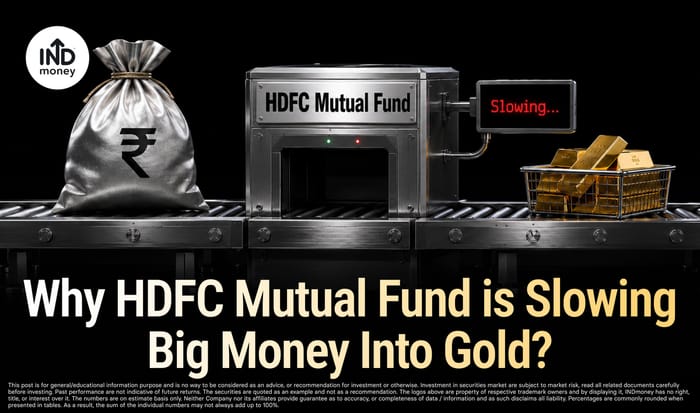
In June 2026, HDFC Mutual Fund, which runs India's one of the largest gold ETF, announced it would temporarily restrict large investments into two of its gold schemes. For most investors, this came without warning.
If you invest in gold ETFs or are thinking about it, this news may have raised a simple question: Is something wrong with gold ETFs? The short answer is no. But understanding why HDFC made this move reveals something important about how gold ETFs actually work, something most investors never need to think about, until a situation like this makes it matter.
What Did HDFC Actually Change?
HDFC Mutual Fund announced two separate restrictions, effective from early June 2026.
For HDFC Gold ETF: From June 8, 2026, large investors, specifically those investing ₹25 crore or more directly with the fund house, will not be able to make fresh investments. This is called a "creation-unit" restriction. It applies to institutional investors and market makers (intermediaries who help keep the ETF running smoothly on the exchange), not to ordinary retail investors buying on NSE or BSE.
For HDFC Gold ETF FoF: Lump-sum purchases and switch-ins (moving money from another scheme into this one) will be capped at ₹10 lakh per PAN per calendar month. This applies to transactions placed after 3 PM on June 5, 2026.
What is not affected: If you are a regular investor buying HDFC Gold ETF units on NSE or BSE through your broker or app, you can continue doing so normally. The exchange-trading route is not restricted.
| Type of Investor | Transaction Type | Impact |
| Retail investor on exchange | Buy/sell on NSE or BSE | No change |
| Large investor (₹25 cr+) | Direct subscription to ETF | Restricted from June 8 |
| Any investor (FoF) | Lump-sum / switch-in | Capped at ₹10 lakh/month per PAN |
Why Did This Happen? The Reason Behind the Restriction
HDFC's official notice uses the phrase "broader economic and market conditions." That is the only stated reason.
To understand what those conditions likely are, it helps to look at what was happening in India's gold market around the same time.
Gold ETFs Are Not Just Digital: They Need Real Gold
Here is a mechanic most investors never think about: when a large investor puts ₹25 crore or more directly into a gold ETF, the fund house needs to source physical gold to back those new units. It cannot simply create units backed by nothing. The gold has to be bought, imported, valued, and held in custody.
This process is called creating new units, and it depends on the fund's ability to source physical gold at a predictable price and within a reasonable timeframe.
When sourcing gold becomes difficult or unusually expensive, the fund faces a problem: it can take in money, but it cannot efficiently convert that money into the physical gold required to back the new units.
India's Gold Import Situation in 2026
India does not mine significant quantities of gold. It imports almost all of the gold it uses, for jewellery, investment, and financial products including ETFs.
In July 2024, India cut gold import duty sharply, reducing BCD from 10% to 5% and AIDC from 5% to 1%. On May 13, 2026, the government reversed course and raised gold and silver import tariffs from 6% to 15%.
In plain terms: the cost of importing one kilogram of gold into India roughly doubled due to taxation. A fund house sourcing gold to back new ETF units is paying significantly more per gram than it was a year ago.
On top of this, India's April 2026 gold imports fell to approximately 15 tonnes, near a 30-year low. Banks that normally import gold on behalf of institutions paused shipments after an unexpected 3% IGST demand created pricing uncertainty. India typically imports far more gold than this, so this was a meaningful supply disruption.
Investment Demand Was Running Unusually High
At the same time, Indian investors were putting record amounts of money into gold ETFs. The World Gold Council reported that Q1 2026 was a record quarter for Indian gold ETF demand, with net inflows of 20 tonnes.
This created an unusual tension: financial demand for gold ETFs was at record highs, while the physical gold supply chain was under stress. Importing gold had become more expensive and more complicated.
The result: HDFC chose to slow large inflows until conditions normalise, rather than risk a situation where the fund holds more cash than it can deploy into physical gold at a fair price.
Common Confusion: "Does This Mean Gold ETFs Are Risky Now?"
This is the most natural question, and the answer is: this restriction is not a signal that gold ETFs are unsafe or that HDFC's scheme is in trouble.
The restriction is operational, not financial. HDFC is not saying gold is a bad investment. It is saying: sourcing physical gold right now is complicated, and rather than take in more money than it can efficiently deploy, it is temporarily slowing large inflows.
The existing units you hold are unaffected. The fund's gold continues to be held in custody. The NAV (Net Asset Value, the per-unit value of the fund) will continue to reflect gold prices normally.
The distinction matters: a fund restricting fresh subscriptions is very different from a fund freezing redemptions (stopping you from selling). HDFC has not done the latter.
What Should a Regular Investor Keep in Mind?
- Exchange trading is unaffected. If you buy HDFC Gold ETF through INDmoney, or any other broker on NSE or BSE, the restriction does not apply to you. You can continue buying and selling normally.
- The FoF cap does affect regular investors. If you invest via HDFC Gold ETF FoF (the fund-of-fund route, not the direct ETF), lump-sum investments are now capped at ₹10 lakh per PAN per month. SIPs (Systematic Investment Plans), where money goes in as smaller automatic instalments, are not mentioned as restricted.
- HDFC has not cited import duty as the reason. Their stated reason is "broader economic and market conditions." The import-duty context is external reporting and analysis, not an official HDFC statement.
- Tracking error could be worth watching. Tracking error is the gap between how much the ETF's NAV moves versus how much gold prices actually moved. When a fund's physical gold sourcing gets out of sync with inflows, tracking error can widen. This is worth monitoring in future factsheets, though it is too early to say this has happened.
- The restriction is stated as temporary. HDFC has not given a fixed end date but has described this as a temporary measure pending a review of conditions.
The Bottom Line
Gold ETFs are built on a simple idea, give investors easy access to gold without the hassle of physical ownership. But behind every unit is a real supply chain: gold has to be imported, taxed, priced, and stored.
HDFC's restriction is a signal that India's gold supply chain is currently under stress, import costs have roughly doubled due to duty changes, and physical supply disruptions have made sourcing unusually difficult. The fund is managing a gap between financial demand (which is high) and its ability to source physical gold (which is constrained).