

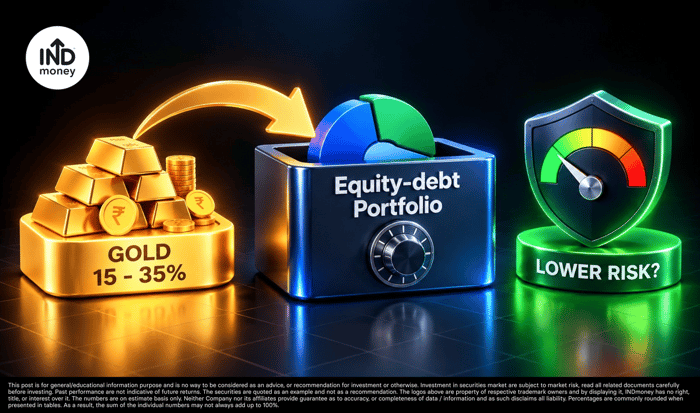
- What Changes When You Add Gold?
- How Do You Know Whether Risk Has Fallen?
- What Does the Research Show?
- Why Can Gold Help, and Where Can It Disappoint?
- Does It Matter Whether Gold Replaces Equity or Debt?
- What Should Investors Check Before Adding More Gold?
- Author’s Take
Adding gold to a portfolio can improve returns. But a higher return does not automatically mean your money faced less risk. You also need to know how much the portfolio fell along the way and how long it took to recover.
That matters when your savings are meant for a house, education or retirement. A strong long-term return offers little comfort if the portfolio is down when you need the money.
What Changes When You Add Gold?
If you add gold without investing more money, you must reduce another holding. That could be equity, which means shares in companies, or debt, which includes investments such as bonds.
For example, a portfolio with 50% equity and 50% debt could become 50% equity, 25% debt and 25% gold. You now own three types of investments, but your exposure to the stock market has not changed. You have replaced half your debt allocation with gold.
This is why asset allocation, or how you divide your money across investments, matters. If the debt portion was meant to provide stability or fund an upcoming expense, replacing it with gold changes how the portfolio serves that goal.
How Do You Know Whether Risk Has Fallen?
Returns tell you how much your money grew. To understand the risk taken along the way, look at three measures:
- Volatility: How widely returns move up and down. Lower volatility generally means a smoother investment journey.
- Maximum drawdown: The biggest fall from a previous high to a later low. This shows how severe the worst loss was during the period studied.
- Recovery time: How long the portfolio takes to regain its earlier high.
Suppose your portfolio falls from ₹10 lakh to ₹8 lakh. That is a 20% loss, but getting back to ₹10 lakh requires a 25% gain. If you need to withdraw before it recovers, you may have to sell more units to meet the same expense.
These measures answer different questions. A portfolio can have smaller usual fluctuations and still suffer a sharp fall. Even recovering to its old value does not fully restore its purchasing power if prices have risen in the meantime.
What Does the Research Show?
WhiteOak Capital’s September 2024 study compared different combinations of equity, debt and gold using data from January 2001 to June 2024.
A portfolio with 25% equity and 75% debt had an average one-year return of 9.8%. Changing the mix to 25% equity, 55% debt and 20% gold raised that figure to 11.1%. The variation in those returns fell slightly, from 6.9% to 6.8%.
Gold improved the return in this comparison, while the reduction in volatility was small. But the figures need careful reading: the study averaged many one-year periods starting on different days. The 11.1% figure is therefore not the compounded annual growth rate of one investment held throughout the study.
The volatility figure also measures variation across those one-year returns, rather than daily price changes. These 2024 findings do not independently confirm newer figures reported for September 2026, and the comparison alone does not establish the worst fall or exact recovery time.
Why Can Gold Help, and Where Can It Disappoint?
Gold can help because it often reacts differently from shares and bonds. When one investment struggles, another may hold up better. This is the idea behind diversification.
However, these relationships can change. Gold and shares can both fall during a market panic as investors sell assets to raise cash. Gold can also remain below an earlier price high for years, so it cannot guarantee protection whenever money is needed.
Gold itself pays no interest and earns no business profits. Its return depends mainly on changes in its price. Bonds may provide interest income, although their market value can fall when interest rates rise or the borrower’s finances weaken.
The type of debt matters too. A long-term government-bond investment can react strongly to interest-rate changes. A short-term debt fund or a deposit held for an upcoming payment serves a different purpose. Findings about replacing a long-term bond index with gold cannot be applied to every debt mutual fund.
Inflation affects both investments, but not in a fixed way. It reduces the buying power of fixed interest payments, while higher interest rates can make an asset that pays no interest less attractive. Gold prices depend on several forces, so higher inflation does not always produce higher gold returns.
For Indian investors, currency movements also matter. Gold is priced internationally in dollars, so a weaker rupee can increase its rupee value or soften a fall in the global price. For example, if gold falls 10% in dollars while the dollar becomes 5% more expensive in rupees, gold’s rupee value falls by about 5.5%, assuming other pricing factors stay unchanged.
That is why comparisons for Indian investors should use gold returns in rupees. Import duties, local premiums and product costs can also affect the return they actually receive.
Does It Matter Whether Gold Replaces Equity or Debt?
A separate historical calculation makes this choice clearer. It used annual returns published by WhiteOak for 14 financial years, from FY2011 to FY2024, and reset each portfolio to its chosen allocation once a year.
The starting portfolio held 60% equity and 40% debt. Two alternatives added 10% gold: one reduced debt, while the other reduced equity.
| Equity / debt / gold | Annual growth rate (CAGR) | Variation in annual returns | Biggest fall visible at financial-year ends |
| 60% / 40% / 0% | 10.89% | 12.97% | 9.78% |
| 60% / 30% / 10% | 11.32% | 12.33% | 7.80% |
| 50% / 40% / 10% | 10.86% | 10.17% | 4.52% |
CAGR expresses the investment’s compounded growth as a yearly rate. The next column shows how much returns varied from year to year. The final column shows falls measured only at financial-year ends, so it can miss deeper losses during the year.
Replacing debt with gold raised annual growth from 10.89% to 11.32%, with slightly lower volatility and a smaller year-end decline. Replacing equity produced a lower growth rate of 10.86%, but a smoother journey and a smaller visible decline.
Both alternatives held 10% gold, yet the outcomes were different. Reducing exposure to shares or equity mutual funds changes how much the portfolio participates in stock-market gains and losses. Reducing debt leaves that equity exposure unchanged.
There are limits to this comparison. It uses short-term debt, unlike the long-term government-bond index in the earlier study. It also uses annual observations, so the risk figures from the two tests are not directly comparable.
In this calculation, all three portfolios were above their earlier year-end highs by FY2021-end after the FY2020 fall. The annual data cannot show the exact recovery dates or the deepest losses within each year. Results also depend on the chosen dates: this test excludes both the 2008 financial crisis and the 2025–2026 gold rally.
A World Gold Council report offers another example. Its December 2006–December 2025 analysis found better returns relative to risk and smaller drawdowns with 7.5%–15% gold in the portfolios tested. But it made room for gold by reducing both shares and bonds, and included overseas shares and different bond investments.
That means the studies tested different choices. Their results cannot establish one ideal gold percentage for everyone. The World Gold Council also represents the gold industry, making its assumptions and methods relevant when assessing its conclusions.
What Should Investors Check Before Adding More Gold?
Start with when you need the money and how much loss you can handle. Money set aside for a near-term expense should not depend on gold recovering by a particular date. A longer holding period gives you more flexibility, but it does not guarantee recovery before your deadline.
Next, count the gold you already own. Physical gold, sovereign gold bonds, gold ETFs and gold held inside multi-asset funds can all add to your exposure. Family jewellery is part of household wealth, but it may not be available to sell for an investment goal.
Then consider the product’s costs and how easily you can sell it. Physical gold can involve making charges, storage costs and resale deductions. Gold ETFs have fund expenses, may not exactly match gold-price movements and can have gaps between buying and selling prices. Trading activity also varies between ETFs.
Gold mutual funds often invest through gold ETFs, so costs can arise at both levels. Multi-asset allocation funds combine investments, but their allocations, charges and adjustment rules can differ from the studies discussed here.
Finally, decide how you will maintain your chosen mix. Portfolio rebalancing means periodically bringing investments back to their target shares. If gold grows far beyond its planned allocation, rebalancing may involve reducing it and adding to other assets. This helps maintain the intended risk level, although it can involve costs and does not guarantee better returns.
Author’s Take
The useful question is what job gold would do in your portfolio. Adding it can improve diversification, but replacing money reserved for an upcoming expense creates a different risk from reducing equity exposure.
Judge the change by how the whole portfolio supports your goal: its returns, possible losses, recovery time and your ability to stay invested. A better historical return matters only if the revised mix also fits when you need the money.