

- What Has Changed in the OYO IPO DRHP?
- Why Has OYO Reduced Its IPO Size?
- How Strong Are OYO's Latest Financial Results?
- What Does the Smaller OYO IPO Mean for Investors?
- When Will the OYO IPO Open?
- Author's Take: What Should Investors Watch?
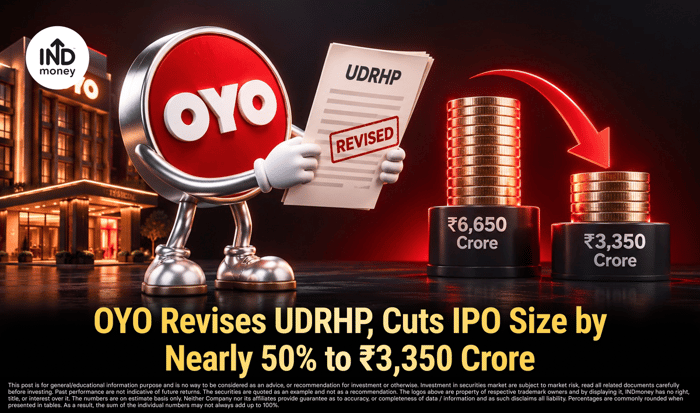
An IPO getting nearly 50% smaller just before its launch naturally raises a question: why does the company now want less money? That is exactly what has happened with OYO's parent, Oravel Stays Limited, which operates under the PRISM brand. In an addendum filed with SEBI on October 26, 2026, the company reduced its planned IPO from ₹6,650 crore to ₹3,350 crore, lowered the amount meant for debt repayment and dropped its proposed pre-IPO fundraising.
The real question for investors is whether OYO's improved financial performance can support the smaller fundraising plan.
What's Covered: The three changes in the latest IPO addendum, the reported reason behind the smaller issue, OYO's latest FY26 financials, and what investors should check before the IPO opens.
What Has Changed in the OYO IPO DRHP?
Oravel Stays filed its Updated Draft Red Herring Prospectus-I (UDRHP-I), dated June 29, 2026, with SEBI in June. Its latest addendum, approved by the board on October 19 and the IPO Committee on October 21, revises the fundraising plan rather than replacing the entire draft prospectus.
| Particulars | Earlier IPO Plan | Latest IPO Plan |
| Fresh issue size | Up to ₹6,650 crore | Up to ₹3,350 crore |
| Money earmarked for debt repayment | ₹4,987.50 crore | ₹2,512.50 crore |
| Pre-IPO placement | Up to ₹1,330 crore proposed | Cancelled |
| Offer for Sale (OFS) | None | None |
Source: Oravel Stays UDRHP-I dated June 29, 2026, and addendum filed with SEBI on October 26, 2026.
The biggest change is the ₹3,300 crore reduction in fresh fundraising, equivalent to approximately 49.6%. The company has also cut its planned debt repayment through IPO proceeds by ₹2,475 crore. Separately, the June draft allowed a possible private placement before the public issue, but that provision has now been removed.
Importantly, the IPO is still entirely a fresh issue. This means the company will receive the funds raised, after expenses, rather than existing shareholders selling their stakes through an OFS. The main purposes of the issue, debt repayment and general corporate purposes, have not changed.
Why Has OYO Reduced Its IPO Size?
The addendum confirms the smaller issue but does not explicitly give improving cash flow as the reason. Before the filing, people familiar with the plan told PTI that stronger cash generation and an improving balance sheet had reduced the company's need to raise money from outside investors.
They also indicated that the business aims to repay remaining debt over the next two to three years using its own cash flows. However, that is a reported plan, not a repayment guarantee.
The company is still setting aside ₹2,512.50 crore for repayment or prepayment of certain borrowings through its subsidiary, Oravel Stays Singapore Pte. Ltd. This works out to 75% of the maximum ₹3,350 crore issue size before IPO expenses. The change is possible under a SEBI communication dated October 12, 2026, referred to in the addendum, which permits eligible IPO issuers opening on or before March 31, 2027, to adjust their fresh issue size by up to 50% without filing a fresh UDRHP-I.
However, the amendment does not mean that OYO has already raised the money or repaid the debt. These are still proposed uses of the funds that the company expects to raise through its IPO.
How Strong Are OYO's Latest Financial Results?
OYO's latest reported full-year figures provide some context for the decision. In its FY26 annual report, released in August 2026, PRISM reported much higher revenue and profit than in FY25.
Its operating cash flow also improved substantially, which matters because debt is ultimately repaid with cash, not merely accounting profit.
| Financial Metric | FY25 | FY26 |
| Revenue from operations | ₹6,252.83 crore | ₹9,357.98 crore |
| Reported EBITDA | ₹1,083.50 crore | ₹2,593.84 crore |
| Profit after tax | ₹244.82 crore | ₹994.18 crore |
| Net cash from operating activities | ₹321.25 crore | ₹2,511.21 crore |
Revenue grew by about 49.7%, helped by a larger international business and a full-year contribution from G6 Hospitality, the owner of the Motel 6 and Studio 6 brands.
Operating cash flow, which represents the actual cash generated from regular business activities, rose much faster than revenue. This improvement supports the possibility that the company could use more of its own money to repay debt rather than depending entirely on IPO proceeds. However, investors should not read the ₹994 crore net profit without context. It included a deferred-tax credit of approximately ₹678 crore, which is an accounting tax benefit rather than cash received from customers.
The company also reported finance costs of approximately ₹1,414 crore in FY26. So even after its operational improvement, debt servicing remains an important cost. This makes future cash generation especially important for understanding whether OYO's smaller fundraising plan is financially sustainable.
What Does the Smaller OYO IPO Mean for Investors?
A smaller fresh issue can lead to less dilution of existing shareholders because the company may issue fewer new shares than under a larger fundraise. But that is not certain until the IPO price and final number of shares are announced.
A smaller issue also does not automatically mean a cheaper valuation or better listing performance. There is another side to the decision. Under the earlier plan, nearly ₹5,000 crore was earmarked to repay borrowings. Under the revised plan, that amount is about ₹2,500 crore.
This means OYO may have to rely more on future operating cash flow to meet its remaining repayment goals. If business performance stays strong, this could become manageable. However, if cash generation weakens or borrowing costs remain high, debt could continue to put pressure on the company. For IPO investors, the key is to assess the eventual valuation alongside operating cash flow, outstanding borrowings, interest costs and the amount of debt actually repaid. The improvement in reported profit is encouraging, but it should not replace a review of these numbers.
When Will the OYO IPO Open?
As of October 30, 2026, OYO has not announced an official IPO opening date, price band or lot size. The October 26 document is an addendum to the draft filing, not the final Red Herring Prospectus (RHP). The final RHP will provide updated information that investors should read before evaluating the offer.
The next important disclosures are the final price band, the number of shares being issued, updated financials and borrowings, and the final use-of-proceeds details. Without a share price and final share count, it is too early to calculate a reliable IPO valuation or price-to-earnings ratio.
Author's Take: What Should Investors Watch?
OYO's decision to nearly halve its IPO is not automatically a positive or negative signal. The company now has much stronger reported revenue and operating cash flow than a year earlier, but the smaller amount reserved for debt repayment means that its financial improvement must continue after the IPO as well.
Before evaluating the issue, investors should compare the final IPO valuation with FY26 operating performance, check how much debt will remain after the proposed repayment, and see whether operating cash flow can cover ongoing interest payments and future commitments.
The key question is no longer just how much OYO plans to raise. It is whether OYO can maintain growth while steadily reducing its dependence on debt.
For more open and upcoming IPOs, visit INDmoney’s IPO tracker.