

- The Graveyard of Airlines: An Overview
- Why Airlines Keep Failing in India
- Why Some Carriers Survived and Grew
- A Tough Market That Still Soars
At some point in the late 2000s, flying in India felt glamorous again. Airports were expanding, aircraft orders were splashed across newspapers, and airline founders were celebrities. Jet Airways symbolised success. Kingfisher sold an aspirational lifestyle. New airlines kept launching, convinced that India’s growing middle class would lift everyone into the air.
But aviation has a way of humbling optimism. One by one, those same airlines disappeared from departure boards. Aircraft were repossessed. Salaries went unpaid. Brands that once dominated billboards quietly shut shop. Today, India is one of the fastest-growing aviation markets in the world and also one of the hardest places to run an airline.
Let’s break down with this blog how India became such a tough market for airlines, why so many failed despite booming demand, and what a handful of survivors did differently to stay airborne.
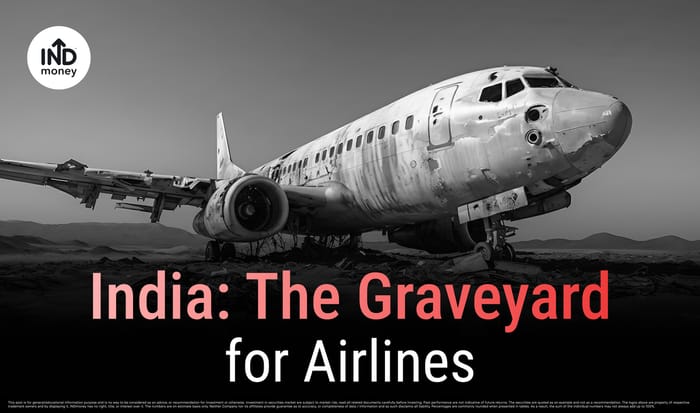
The Graveyard of Airlines: An Overview
Since the airline sector opened up in the 1990s after liberalisation, India has seen wave after wave of airline launches. Some were full-service carriers chasing premium travellers. Others were low-cost disruptors promising cheap fares and high volumes. A few focused on regional routes or niche markets. What followed was a steady churn. More than 25 airlines have shut down since liberalisation. Some lasted barely a few years.
Some notable closures include:
- Jet Airways, the once-premier private airline that ceased operations in 2019 after years of mounting losses and inability to secure funding.
- Kingfisher Airlines ground to a halt in 2012 when its license was revoked amid severe financial distress.
- Go First (formerly GoAir) filed for bankruptcy in 2023 and was ordered liquidated by an Indian tribunal in early 2025 after failed revival efforts.
- Air Deccan, Air Costa, Air Pegasus, TruJet and several others each ceased operations due to chronic cash shortages, regulatory setbacks or unsustainable business models.
These weren’t obscure startups. They were well-funded, widely trusted, and deeply embedded in India’s travel ecosystem. Their collapse wasn’t sudden. It was slow, visible, and painful.
Why Airlines Keep Failing in India
To understand why airlines struggle here, you have to look past passenger growth numbers and focus on how unforgiving the business really is.
1. Sky-High Operating Costs
Fuel is the single biggest cost for airlines, and in India it has consistently been expensive. State-level taxes, volatile global prices, and currency swings mean fuel bills are unpredictable and often punishing. Add airport charges, leasing costs, and maintenance expenses, and margins shrink fast.
For airlines without deep balance sheets, even a small spike in costs can turn a profitable quarter into a loss-making year.
2. Cut-throat Competition and Low Fares
India’s aviation growth has been built on affordability. That’s good for passengers but brutal for airlines. When multiple carriers fight for the same routes, fares drop quickly. Once prices fall, raising them becomes politically and competitively difficult.
Jet Airways and Kingfisher both struggled in an environment where customers were price-sensitive but costs refused to cooperate. Volume increased, but profitability didn’t follow.
3. Debt and Poor Financial Management
Many airlines expanded faster than their finances allowed. Aircraft were leased aggressively. Routes were added optimistically. Debt piled up quietly in the background.
When cash flows tightened, lenders stepped back. Without fresh funding, operations stalled. Jet Airways’ collapse wasn’t caused by a single bad year. It was the result of years of financial stress finally catching up.
4. Regulatory and Operational Hurdles
Running an airline in India also means dealing with complex regulation, slot constraints at major airports, and high compliance costs. Smaller carriers often found themselves squeezed out of prime routes or unable to scale efficiently.
Survival required not just flying planes, but navigating policy, infrastructure limitations, and bureaucratic friction.
5. External Shocks
Then come the shocks no airline can fully prepare for. Economic slowdowns. Oil price spikes. And most recently, the pandemic. COVID-19 didn’t create weaknesses in Indian aviation. It exposed them. Airlines that were already stretched simply didn’t make it through.
Why Some Carriers Survived and Grew
If the environment is so hostile, how did a few airlines manage to survive?
IndiGo: Efficiency Over Everything
IndiGo didn’t try to be glamorous. It didn’t chase premium branding or complex offerings. It focused obsessively on costs, punctuality, and scale. A largely uniform fleet, quick aircraft turnaround times, and disciplined route planning allowed it to operate more efficiently than peers.
When demand surged, IndiGo was ready. When demand fell, it had the balance sheet to absorb the shock. Its dominance today is less about luck and more about consistency.
SpiceJet: Staying Flexible
SpiceJet, while smaller than IndiGo, has weathered its own storms through a mix of tactical pricing, strategic route choices and periodic recapitalisation. Its survival underscores the importance of nimble cost management and adapting to market swings; traits that carriers that failed often lacked.
Air India: Reinvention Instead of Exit
Air India’s survival is different. For years, it struggled under debt and inefficiency. But its privatisation marked a reset rather than an end. Fresh capital, fleet renewal, and management overhaul have given it another chance, something many private airlines never received.
A Tough Market That Still Soars
India’s airline graveyard tells a clear story. Growth alone doesn’t guarantee survival. In aviation, execution matters more than ambition. Cash discipline beats brand appeal. Scale and efficiency often matter more than market share headlines.
India will continue to add passengers, airports, and aircraft. New airlines will emerge. Some will fail again. But those that understand the economics of flying in India and respect how unforgiving it can be, stand a chance.
The skies are crowded. The margins are thin. And survival, as history shows, is never guaranteed.
Disclaimer
Investments in the securities market are subject to market risks. Read all the related documents carefully before investing. The securities are quoted as an example and not as a recommendation. This is nowhere to be considered as advice, recommendation, or solicitation of an offer to buy or sell or subscribe for securities. INDStocks SIP / Mini Save is a SIP feature that enables Customer(s) to save a fixed amount on a daily basis to invest in Indian stocks. INDstocks Private Limited (formerly known as INDmoney Private Limited) 616, Level 6, Suncity Success Tower, Sector 65, Gurugram, 122005, SEBI Stock Broking Registration No: INZ000305337, Trading and Clearing Member of NSE (90267, M70042) and BSE, BSE StarMF (6779), SEBI Depository Participant Reg. No. IN-DP-690-2022, Depository Participant ID: CDSL 12095500, Research Analyst Registration No. INH000018948 BSE RA Enlistment No. 6428. Refer to https://indstocks.com/pricing?type=indian-stocks; https://www.indstocks.com/page/indian-stocks-sip-terms-and-condition for further details.