

- The Truth About IPOs and F&O: "Lottery Tickets"
- Managing Return Expectations: A Reality Check
- What Does Being an "Aggressive Investor" Really Mean?
- How to Value a Stock: The Grocery Store Analogy
- The Reality of Small and Mid-Cap Stocks: "Rats vs. Giraffes"
- Global Diversification and Choosing the Right Fund
- Conclusion
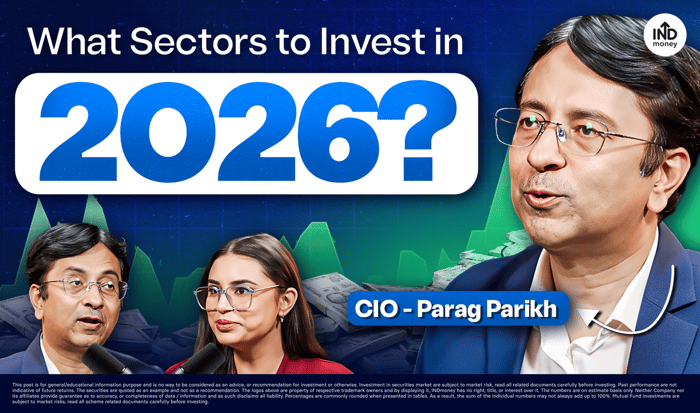
"Excessive optimism is there in the IPO space." This cautionary statement from Rajiv Thakkar, CIO of Parag Parikh Mutual Fund, set the theme for a recent insightful podcast hosted by Shagun Gautam of INDmoney.
For those who follow the Indian mutual fund industry, Rajiv Thakkar needs no introduction. Known for his calm demeanour and value-investing philosophy, he manages one of India's most popular mutual funds. In this candid conversation, he breaks down the reality of IPOs, how to value a stock like a grocery store, and why not every small company grows into a giant.
Let’s break down the key takeaways from this masterclass on sensible investing.
The Truth About IPOs and F&O: "Lottery Tickets"
Rajiv Thakkar expressed concern about the current market sentiment, specifically regarding Initial Public Offerings (IPOs) and Futures & Options (F&O). He believes there is "excessive optimism" in the market right now.
Here is what he highlighted:
- The Lottery Mindset: Many investors treat IPOs like lottery tickets, applying just to get an allotment and exiting immediately on listing day for a quick profit.
- The F&O Trap: People often view Futures and Options as "free money." However, the reality is harsh. Thakkar cited SEBI data showing that retail traders lost a staggering ₹1.07 lakh crore in a single year.
- Caution is Key: Investors need to be careful and not get swept away by the hype of easy money.
Here is the link to the Youtube Video.
Managing Return Expectations: A Reality Check
Parag Parikh Flexi Cap Fund has seen its Assets Under Management (AUM) jump from ₹3.8 crore to over ₹1.44 lakh crore. But should investors expect the same high returns moving forward? Rajiv Thakkar gave a crucial reality check.
- Inflation Matters: Returns must be viewed in the context of inflation. If inflation drops from 10% to 3%, your nominal returns (the number you see) will also likely come down.
- Don't Be Disappointed: If you enter the market expecting a 15% return when inflation is low, you might be disappointed with a 12% return, even though that 12% is actually very good in real terms.
What Does Being an "Aggressive Investor" Really Mean?
When asked if he is an aggressive investor, Thakkar clarified a common misconception.
- Aggression vs. Gambling: Being aggressive doesn't mean betting everything on one number at a roulette table or trading F&O.
- The Real Definition: For a young person with a stable income, "aggression" means allocating a high amount of money to equities (stocks) rather than safe options like Bank FDs or insurance policies that offer low returns (4-5%).
- Sensible Compounding: True aggression is buying sensible companies at reasonable prices and letting them compound over the long term.
How to Value a Stock: The Grocery Store Analogy
Valuation can be confusing with jargon like DCF, EVA, and Beta. Rajiv Thakkar simplified this beautifully by comparing a stock to a corner grocery store.
If you were buying a grocery store, what would you check?
- Asset Base: Do you own the shop, or is it rented? What is the inventory worth?
- Sales & Profit: What are the annual sales? After paying for electricity, staff, and delivery, how much profit is left?
Thakkar advises investors to use this same simple logic for listed companies. Forget the jargon; look at the assets, sales, and actual profits.
The Reality of Small and Mid-Cap Stocks: "Rats vs. Giraffes"
There is a fascination that small-cap stocks will make exponential money. Thakkar used a brilliant nature analogy to explain the risks.
- Saplings vs. Oak Trees: Large caps are like Oak trees (stable). Small caps are like saplings. While saplings have growth potential, not every sapling becomes a tall tree; some remain shrubs or bonsai plants.
- The Rat and the Giraffe: As he wittily put it, "Every animal does not become a giraffe. A rat will remain a rat." The problem is, when buying a small stock, it isn't always obvious if you are buying a baby giraffe or a rat.
- Limit Your Exposure: Because small caps can swing wildly (up and down), he advises limiting allocation to this space to 10-20%. Putting 50% or more of your money here is dangerous.
Global Diversification and Choosing the Right Fund
Finally, the conversation touched on where to invest and how to pick a fund.
- Go Global: India is a major economy, but it isn't everything. Global giants like Tesla or BYD are not listed here. Thakkar advocates for global diversification to reduce country-specific risk.
- Passive vs. Active: For beginners, passive funds (Index funds like Nifty 50) are a good start.
- Selecting an Active Fund: If you choose an active fund, look for a fund house with a longstanding reputation and a consistent track record.
- Don't Overcomplicate: Diversification should be across asset classes (Equity, Debt, Gold), not just buying 10 different schemes that do the same thing.
Conclusion
Rajiv Thakkar’s insights serve as a grounding guide for investors in a hyped-up market. His advice is simple: avoid the "lottery" mindset of IPOs, understand that small caps carry risks, and focus on sensible, long-term compounding rather than chasing quick returns. As the podcast highlights, successful investing isn't about complex formulas; it's about common sense and patience.
Disclaimer: The content is meant for education and general information purposes only. Past performance is not indicative of future returns. Mutual Funds are non-exchange traded products, and INDstocks is merely acting as a mutual fund distributor. All disputes with respect to distribution activity, would not have access to the exchange investor redressal forum or arbitration mechanism. Mutual Fund investments are subject to market risks, read all scheme related documents carefully before investing. INDstocks Private Limited (formerly known as INDmoney Private Limited) 616, Level 6, Suncity Success Tower, Sector 65, Gurugram, 122005, SEBI Stock Broking Registration No: INZ000305337, Trading and Clearing Member of NSE (90267, M70042) and BSE, BSE StarMF (6779), AMFI Registration No: ARN-254564, SEBI Depository Participant Reg. No. IN-DP-690-2022, Depository Participant ID: CDSL 12095500, Research Analyst Registration No. INH000018948 BSE RA Enlistment No. 6428.