

- Why the Government Stepped In
- How Big This Cut Is for IndiGo
- Impact on Revenue
- Impact on Costs and Margins
- Effect on Market Share
- Reputation and Passenger Behaviour
- Increased Regulatory Pressure
- Long Term Growth Impact
- What Shareholders Should Watch
- Conclusion
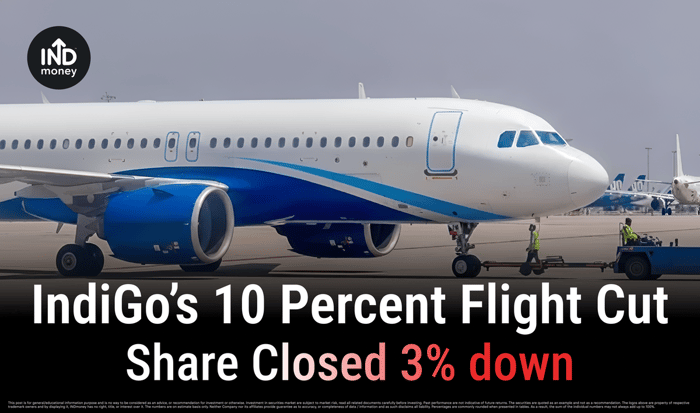
IndiGo shares closed more than 3 percent down today after the aviation ministry ordered the airline to cut its flight schedule by 10 percent. This article looks at why the government stepped in, how big this cut really is, what it means for IndiGo’s daily operations and how shareholders may be affected in the coming months.
Why the Government Stepped In
The ministry said IndiGo’s internal mismanagement of crew rosters and communication led to large scale inconvenience for passengers. To bring stability, the government has ordered a 10 percent reduction in IndiGo’s winter schedule while ensuring that all destinations remain covered. IndiGo has also been directed to complete pending refunds, speed up baggage handovers and follow fare caps without exception.
How Big This Cut Is for IndiGo
IndiGo usually operates more than 2200 domestic flights a day. A 10 percent curtailment means more than 230 flights are removed from the schedule. The important point is that this cut applies to IndiGo’s approved winter schedule, which runs till March. This means the restriction is not just for a few days but could stay in place for the entire season unless the ministry is fully satisfied that operations have stabilised. For an airline built on high frequency and fast turnaround, this is a meaningful reduction.
Impact on Revenue
Flying fewer flights means IndiGo has fewer seats to sell, which reduces short term revenue. Fare caps on many routes also limit the airline’s ability to raise prices during this period. Along with this, IndiGo has already paid large amounts in refunds for cancelled flights. These combined pressures are likely to weigh on earnings in the next quarter.
Impact on Costs and Margins
Some costs fall when flights reduce, but many major expenses remain fixed. Lease rentals, salaries and overheads do not change much even when capacity is cut. This raises the cost per flight. IndiGo is also spending more on compensation and service recovery. With lower revenue and higher unit costs, near term margins are expected to remain weak.
Effect on Market Share
IndiGo has the largest domestic market share in India. But a cut in capacity gives competitors a chance to add flights and capture demand. Airlines like Air India, Vistara and Akasa have already been asked to support routes affected by IndiGo’s reduction. If passengers shift to these airlines even for a short time, IndiGo may lose share on key routes.
Reputation and Passenger Behaviour
The recent disruptions have affected IndiGo’s image. Many passengers faced long delays and confusion. Even after operations improve, some may choose other airlines for a while. But because IndiGo still offers the widest network and frequency, many travellers may return once stability is clear. Restoring trust will depend on consistent performance in the next few weeks.
Increased Regulatory Pressure
The order shows that regulators are ready to intervene when they see operational weakness. IndiGo will now operate under closer monitoring of its schedules, rostering and service standards. This raises compliance requirements and limits how aggressively the airline can grow until the regulator is confident about its internal systems.
Long Term Growth Impact
IndiGo has ambitious expansion plans supported by a large aircraft order book. But growth depends on pilot availability, planning and regulatory approval. The current cut slows down that pace. If the airline strengthens its processes and improves scheduling and staffing, it can return to growth. The long term outlook for India’s aviation market remains strong, but investors will expect smoother execution from IndiGo.
What Shareholders Should Watch
Shareholders should look for clarity on how long the flight curtailment will last. They will also want updated guidance on revenue and profit impact for the coming quarters. Most importantly, investors must hear what permanent fixes are being made to avoid a repeat of this disruption. Without this clarity, the market may continue to stay cautious on the stock.
Conclusion
The ministry’s 10 percent cut is both a corrective step and a reminder that strong demand alone cannot protect an airline from operational failures. For IndiGo, the next few months will be key. The airline needs to stabilise its operations, rebuild trust and demonstrate that this setback will not slow its long term plans. For shareholders, the focus will be on how quickly IndiGo returns to normal and how confidently it can grow once again.