

- A Walk Through History: What Markets Tell Us About Budget
- Tradable Scenarios After Budget Announcements
- What Traders Typically Do Right After Budget
- Practical Trading Strategies Post-Budget
- What to Keep in Mind for Trading on Budget 2026
- Final Thought
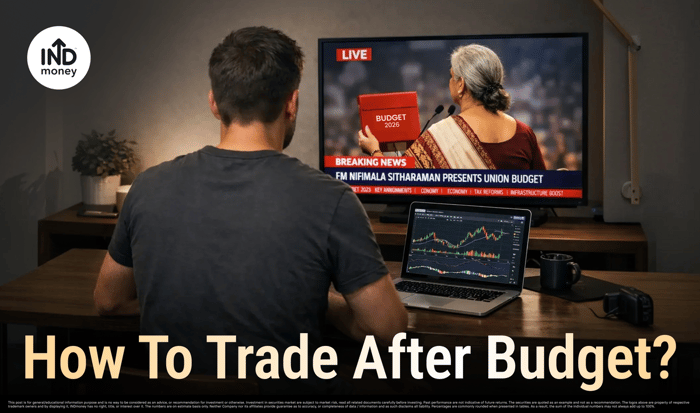
Budget Day can feel like the stock market’s IPL, yet what happens next is where the real game is played. Today on February 1, 2026, India is all ready to witness the Union Budget 2026 to be presented by Finance Minister Nirmala Sitharaman, her ninth consecutive budget. Markets are open in a rare Sunday trading session to react in real time to policy cues.
But once the speeches and headlines fade, the real question for traders becomes clear: what next? How does one trade effectively after a budget announcement that sets economic direction for an entire year?
Let’s break down with this blog what history, data, and trader behaviour tell us about post-Budget trading and how you can think about structuring trades after Budget 2026.
A Walk Through History: What Markets Tell Us About Budget
Budget announcements don’t move markets in a straight line. Swift intraday swings are common, but the real movement often comes after the event, as investors digest details and reposition. Historical data suggests:
- Over the last 15 Union Budgets, key indices showed a slightly positive bias on Budget day, with average gains for Sensex and Nifty, but also sharp intraday swings.
- In the week after a Budget, Sensex has historically closed higher on 11 out of 15 occasions, with an average gain of around 2%.
- Over three months post-Budget, the medium-term bias has often favoured markets too, with average gains near 6-7%, though there have been episodes of short-term weakness as well.
What this tells us is that the Budget itself rarely decides the full market direction, it’s the expectations versus reality and the follow-through over days and weeks that matter.
Tradable Scenarios After Budget Announcements
Every Budget brings a series of policy outcomes and traders essentially place probabilities on those outcomes. Here’s how to think about key scenarios after Budget 2026:
1. Growth-Focused Signals Get Rewarded
If the Budget leans toward increased capital expenditure, infrastructure push, tax benefits to industries or investment incentives, markets tend to rally, especially in cyclical sectors. Infrastructure, capital goods, and select financials often outperform when real growth cues are confirmed.
2. Fiscal Slippage or Higher Borrowings Can Weigh
Wider fiscal deficits or much higher borrowing than expected can pressure bond yields and dampen risk assets. Traders may rotate out of rate-sensitive sectors like realty or banks if debt numbers surprise to the upside.
3. Sector-Specific Shocks Create Short-Term Trades
Announcements like tax cuts for EVs, changes in capital gains taxes, or incentives for defence manufacturing can cause sectoral rotations worth trading on short-term, event-driven momentum.
What Traders Typically Do Right After Budget
Market reactions can broadly be grouped into a few well-tested trading behaviours:
- Trade the Gap, Not the Noise: Budget day’s opening moves are largely noise. Intraday volatility is high, but many seasoned traders look past day’s range to wait for post-Budget confirmation; a break above key resistance or below support levels, before positioning.
- Sectors Over Indices: Instead of broad index plays, active traders often focus on sectors that directly benefit or lose from the new fiscal roadmap, such as infrastructure, defence, tech or commodities, where news impact is most direct.
- Position for the Next 5-10 Days: Most post-Budget trends, at least in the past 15 cycles, solidify within the first one to two trading weeks after announcements. This is where volume patterns, institutional flows, and earnings expectations begin to align with policy outcomes.
Practical Trading Strategies Post-Budget
Here are structured ways to trade after the Budget has been announced:
- Trend Plays with Confirmation: After Budget day, wait for technical confirmation, e.g., breakout above recent swing highs on heavy volume or vice versa before entering a long or short position. This filters noise and aligns trades with market conviction.
- Sector Rotation Bets: Identify sectors highlighted by the Budget and pair them against laggards. A relative strength strategy can work well here.
- Range-Bound Options Strategy: If the market is choppy, consider short strangle or iron condor options strategies on Nifty or Bank Nifty to benefit from congestion bands with defined risk.
- Stop-Loss First Approach: Given volatility, entering with strict stop-loss levels ensures that if the Budget broadly disappoints traders’ expectations, capital preservation comes first.
What to Keep in Mind for Trading on Budget 2026
- Economic Survey & Expectations Matter: Pre-Budget surveys often shape expectations. The 2026 Economic Survey showed strong growth and tax base expansion, setting a positive baseline.
- Global Backdrop Influences Flows: Foreign investor flows, global interest rates, and macro conditions can outweigh even bold Budget cues in the near term.
- Stay Disciplined: Budget reactions are emotional at first but become rational with time. Patient traders often benefit from waiting for post-Budget clarity.
Final Thought
Budget announcements are headline events, but profit opportunities lie in deciphering what comes after the headlines. As you structure post-Budget trades, blend historical patterns, technical confirmation and macro context for better odds.
For active traders and investors alike, the Budget isn’t a one-day story, it’s the opening chapter of a much longer market narrative.
Disclaimer
Investments in the securities market are subject to market risks, read all the related documents carefully before investing. The securities are quoted as an example and not as a recommendation.This is nowhere to be considered as an advice, recommendation or solicitation of offer to buy or sell or subscribe for securities. INDStocks SIP / Mini Save is a SIP feature that enables Customer(s) to save a fixed amount on a daily basis to invest in Indian Stock. INDstocks Private Limited (formerly known as INDmoney Private Limited) 616, Level 6, Suncity Success Tower, Sector 65, Gurugram, 122005, SEBI Stock Broking Registration No: INZ000305337, Trading and Clearing Member of NSE (90267, M70042) and BSE, BSE StarMF (6779), SEBI Depository Participant Reg. No. IN-DP-690-2022, Depository Participant ID: CDSL 12095500, Research Analyst Registration No. INH000018948 BSE RA Enlistment No. 6428. Refer https://indstocks.com/pricing?type=indian-stocks; https://www.indstocks.com/page/indian-stocks-sip-terms-and-condition for further details.