

- What Has Changed Inside Micron?
- Why Crucial No Longer Fits
- What Happens to Crucial Products Now
- How This Reshapes the Consumer Memory Market
- Why This Decision Points to Micron’s Future
- Final Takeaway from Crucial Closure
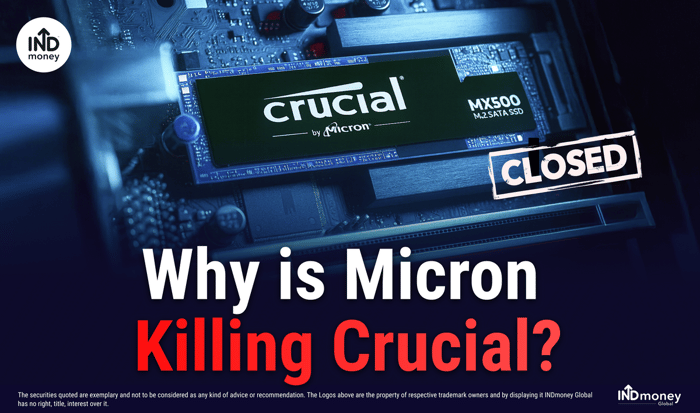
Crucial was never a fringe brand. For years, it sat at the centre of the DIY PC world, offering dependable RAM, straightforward SSDs and pricing that didn’t require a second thought. The brand carried weight because it rode on Micron’s manufacturing credibility. That’s precisely why the industry reacted sharply when it became clear that Micron was quietly stepping away from the consumer-facing Crucial line.
No major announcement, no public roadmap change, just a slow pullback in channel inventory at a time when global attention is shifting toward AI-driven computing. The question that immediately surfaced was simple: Why would Micron walk away from a well-loved consumer memory brand?
The explanation lies in how the memory business itself is evolving. Let’s break down Micron’s decision and what it means for the company
What Has Changed Inside Micron?
Micron has undergone a notable internal reset over the past year. Its earnings calls and investor presentations point to one theme repeating across quarters: AI workloads are driving the next phase of memory demand. Servers built for AI training and inference consume far more DRAM than general-purpose systems.
According to industry estimates from TrendForce and IDC, AI server configurations require multiple times the memory capacity seen in standard data centre hardware. This is where Micron now sees its competitive edge. The company is scaling high-bandwidth memory, advanced server DRAM and speciality formats used in accelerators.
These segments come with higher margins, structured long-term contracts and more stable demand visibility. When production lines are constrained, and memory fabs often operate at full tilt, Micron prioritises the products that deliver the strongest returns per wafer.
Retail memory, unfortunately, sits at the opposite end of that profitability spectrum.
Why Crucial No Longer Fits
Crucial was originally built to give Micron a direct link to consumers. It succeeded because Crucial RAM and SSDs offered Micron’s manufacturing quality without branding premiums. That model worked well for a long stretch, but its economics weakened as the market shifted.
- Consumer memory pricing became extremely volatile: Retail DRAM and NAND prices move suddenly based on global inventory cycles. In weak pricing environments, manufacturers struggle to defend margins; in strong cycles, consumers resist the higher retail costs. The swings make planning difficult for a company now aligned to enterprise and AI.
- Maintaining a consumer brand is expensive: Packaging, distribution, retail partnerships, regional certifications, marketing, support, consumer brands carry structural costs that grow over time. For Micron, these expenses were hard to justify against the rising returns delivered by enterprise memory segments.
- Enterprise clients offer more predictable business: Micron’s highest-value customers today include hyperscalers, cloud service providers and major server OEMs. These clients buy at scale, commit through multi-year agreements and demand consistent supply. Compared to this, consumer upgrades are sporadic and heavily price-driven.
With Crucial tied to a market that delivers thinner margins and higher volatility, Micron’s retreat becomes easier to understand.
What Happens to Crucial Products Now
Retailers and distributors have already reported reduced incoming shipments. Crucial RAM kits, Crucial SSDs and portable drives are still available, but new launches are unlikely. The company is expected to honour existing warranties, though the product roadmap is effectively frozen.
Micron has not said it will stop serving consumers altogether. What is clear is that product development and investment will not be directed toward the Crucial brand anymore. Manufacturing capacity previously allocated to consumer RAM will be redirected toward higher-value enterprise lines.
How This Reshapes the Consumer Memory Market
Crucial’s exit has real implications for everyday buyers. It was one of the few brands offering high reliability at reasonable prices. Builders who relied on Crucial RAM for mid-range systems will now look toward Kingston, Corsair, Adata and TeamGroup, brands with strong retail presence but varied pricing strategies.
In the short term, some price fluctuations may appear as retailers adjust inventory. Longer term, the market is expected to balance out because consumer DRAM demand remains steady even if not fast-growing. The absence of Crucial, however, removes a brand that had earned trust through consistency rather than aggressive marketing.
Why This Decision Points to Micron’s Future
Micron’s direction is clear. The company is aligning itself with segments that define the next decade of computing. That includes AI infrastructure, next-generation data centres, automotive memory systems and high-performance mobile devices. These are markets where innovation cycles are faster, customer relationships are deeper and memory requirements are growing, not shrinking.
Three priorities shape Micron’s roadmap today:
- Expanding high-bandwidth memory capacity
- Strengthening enterprise DRAM and SSD portfolios
- Shifting capital expenditure toward advanced nodes
Crucial, while respected, simply does not fit into this high-growth profile. Retiring it helps Micron sharpen its focus and maximise returns on its manufacturing footprint.
Final Takeaway from Crucial Closure
Crucial’s phase-out may feel like the end of an era for DIY PC builders, but for Micron, it is part of a calculated shift toward markets where memory is becoming mission-critical. Crucial played its role well, but the next phase of Micron’s growth will be built elsewhere.
As AI computing, advanced servers and new performance-heavy workloads are reshaping the economics of the semiconductor industry, Micron is reallocating attention to where memory innovation now matters most.
Disclaimer:
The content is meant for education and general information purposes only. Investments in the securities market are subject to market risks, read all the related documents carefully before investing. Past performance is not indicative of future returns. The securities quoted are exemplary and are not a recommendation. This in no way is to be construed as financial advice or a recommendation to invest in any specific stock or financial instrument. Readers are encouraged to verify the exact numbers and financial data from official sources such as company filings, earnings reports, and financial news platforms and to conduct their own research, and consult with a registered financial advisor before making any investment decisions. All disputes in relation to the content would not have access to an exchange investor redressal forum or arbitration mechanism. INDmoney Global (IFSC) Private Limited, Registered office address: Office No. 507, 5th Floor, Pragya II, Block 15-C1, Zone-1, Road No. 11, Processing Area, GIFT SEZ, GIFT City, Gandhinagar – 382355.