

- What Is Driving the Tesla Stock Rally?
- Why Are Q4 Tesla Sales Expected to Be Disappointing?
- Should You Still Invest In Tesla?
- Tesla Narrative Beats Gloomy Outlook
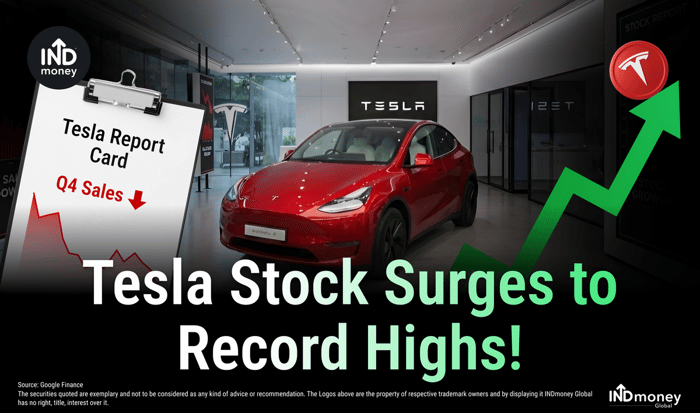
Tesla does not follow the usual traffic rules of the stock market. While most companies are judged quarter by quarter, Tesla is often valued five exits ahead. That pattern played out again this week as Tesla surged to an all-time high, even as concerns around weak Q4 sales and slowing EV demand continued to loom large.
So what exactly pushed Tesla share price into top gear? Short answer: Elon Musk, autonomy, and a market that is clearly betting on the future rather than the rear-view mirror. Add in technology milestones, narrative momentum, and you have a strong movement in the stock.
Let’s break down what is driving Tesla’s stock rally, why Q4 sales expectations remain weak, and why analysts are still leaning bullish.
What Is Driving the Tesla Stock Rally?
The rally has one dominant catalyst: autonomy finally moving from promise to proof.
1. FSD Progress: Elon Musk, the world’s richest man, has confirmed that Tesla is now testing fully driverless vehicles in Austin, Texas, without safety drivers. This is a major escalation from earlier pilot programs that required human supervision.
For markets, this was a signal that Tesla’s Full Self-Driving (FSD) software may be approaching commercial viability. Investors are effectively pricing in the possibility that Tesla can transition from selling cars to selling autonomous mobility.
Think less “car company” and more “AI-powered transport network”.
2. Robotaxi Optionality: Tesla currently operates a Robotaxi-branded ride-hailing service in Texas and California, but with human drivers or safety supervisors. Fully driverless testing hints at a future fleet that can scale without proportional increases in cost.
If successful, this unlocks:
- High-margin, recurring revenue
- Software-like unit economics
- A fundamentally different valuation framework
That optionality alone is enough to move markets.
3. Market Cap Momentum: Following the rally, Tesla’s market capitalisation touched $1.63 trillion as per CompaniesMarketCap data, making it the seventh-most valuable publicly listed company globally.
It now sits just behind Nvidia, Apple, Microsoft, Alphabet, Amazon, and Meta, and ahead of Broadcom. That positioning reinforces Tesla’s perception as a tech-first company, not a cyclical automaker.
Why Are Q4 Tesla Sales Expected to Be Disappointing?
While Tesla’s stock is cruising in the fast lane, the business itself has hit a few unavoidable speed bumps.
Wall Street is already bracing for a softer quarter. FactSet consensus estimates show analysts expecting Tesla to deliver roughly 450,000 vehicles, while Bloomberg’s consensus sits only slightly higher at around 455,000. In Tesla terms, that is not momentum, it is deceleration.
The monthly data tells an even clearer story. In November, Tesla sold close to 40,000 vehicles, marking a sharp 23% year-on-year drop. For a company built on the narrative of relentless growth, that slowdown stands out like a red light on an open highway.
Key Sales Headwinds in Q4 for Tesla:
- Intensifying competition: Lower-cost EVs from BYD, Nio, Xiaomi, and Volkswagen are squeezing Tesla’s pricing power.
- Price cuts losing impact: New, more affordable Model 3 and Model Y variants introduced in October have not meaningfully lifted US or European sales.
- EV tax credit expiry: A major demand pull-forward occurred in Q3 as buyers rushed to lock in federal EV incentives. That tailwind is now gone.
- Brand backlash: Musk’s political activities have triggered consumer resistance in certain markets, weighing on demand.
In short, Q4 is walking into a demand vacuum created by fading incentives and rising competition. In other words, the stock may be racing ahead, but the sales engine is still searching for its next gear.
Should You Still Invest In Tesla?
Despite weak near-term sales visibility, many analysts remain constructive on Tesla’s long-term outlook. In fact, Mizuho recently raised its Tesla price target from $475 to $530 and reiterated a buy rating. The reasoning had little to do with car deliveries and everything to do with software and autonomy.
Analysts are focused on:
- Rapid improvement in Full Self-Driving capabilities
- Faster-than-expected progress toward unsupervised autonomy
- Expansion potential of robotaxi operations beyond Austin to cities like San Francisco
- Operating leverage from software-driven revenue streams
What Analysts Are Really Valuing in Tesla?
| Traditional Auto Lens | Tesla Lens |
| Units sold | Autonomous miles driven |
| Gross margins | Software scalability |
| One-time vehicle sales | Recurring mobility revenue |
| Capex-heavy growth | Asset-light autonomy upside |
In this framework, disappointing Q4 sales are noise, not signal. According to INDmoney’s consensus of 56 analysts, about 43% still rate Tesla a ‘Buy’, yet the average target price of ~$391 implying a 25% downside, a clear sign that conviction in the long-term story coexists with short-term valuation discomfort.
Tesla Narrative Beats Gloomy Outlook
Tesla’s stock rally is not a referendum on its Q4 sales. It is a referendum on belief.
- Belief that Tesla can crack autonomy before EV peers.
- Belief that software can outperform hardware.
- Belief that Elon Musk, controversial as ever, can still bend timelines and markets.
None of this eliminates risk. Regulation, safety, execution, and competition remain formidable. But markets are clearly willing to look past a soft quarter if the long-term story keeps accelerating.
For Tesla, the market is not asking, “How many cars did you sell this quarter?” It is asking, “How close are you to rewriting mobility?” Right now, investors think the answer is: closer than expected.
Disclaimer:
The content is meant for education and general information purposes only. Investments in the securities market are subject to market risks, read all the related documents carefully before investing. Past performance is not indicative of future returns. The securities quoted are exemplary and are not a recommendation. This in no way is to be construed as financial advice or a recommendation to invest in any specific stock or financial instrument. Readers are encouraged to verify the exact numbers and financial data from official sources such as company filings, earnings reports, and financial news platforms and to conduct their own research, and consult with a registered financial advisor before making any investment decisions. All disputes in relation to the content would not have access to an exchange investor redressal forum or arbitration mechanism. INDmoney Global (IFSC) Private Limited, Registered office address: Office No. 507, 5th Floor, Pragya II, Block 15-C1, Zone-1, Road No. 11, Processing Area, GIFT SEZ, GIFT City, Gandhinagar – 382355.