

- How the silver rally began
- When fundamentals gave way to speculation
- Why the fall matters
- Supply deficit is real, but timing matters
- What lies ahead after the sharp correction ?
- Final takeaway
- Disclaimer
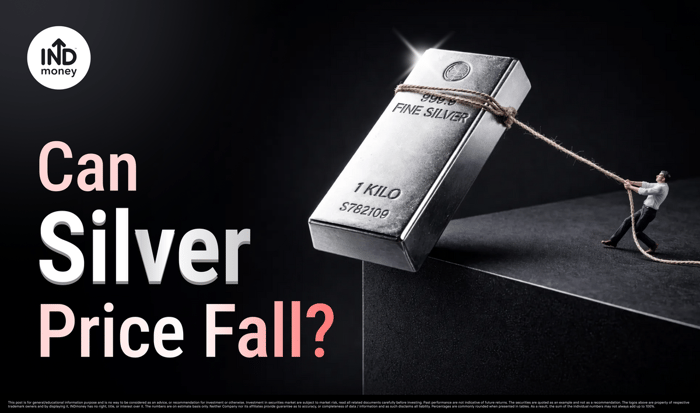
Silver prices in India recently crossed a historic level of around ₹4,20,000 per kg, surprising even seasoned investors. The next day, prices corrected sharply, falling by nearly ₹1,07,971 and closing at ₹2,91,922 on MCX Silver Futures.
This sudden move has opened up an important debate. Is silver still rising on strong fundamentals, or has the rally entered speculative territory where prices are moving beyond rational levels?
To understand this fall, it is important to first understand how the rally was built and where it started to change character.
How the silver rally began
The initial rise in silver prices was driven by real and measurable factors. Global silver supply has been under pressure for years. Mining output has remained largely flat, while demand has continued to grow. This has created a supply deficit that supports higher prices over the long term.
Unlike gold, silver is not just a store of value. More than half of global silver demand now comes from industrial use. Solar panels, electric vehicles, electronics, batteries and advanced technology all rely heavily on silver. As renewable energy and technology adoption increase globally, silver demand has become structural rather than cyclical.
Silver also benefits from its role as a safe-haven asset. Geopolitical tensions, economic uncertainty and expectations of lower interest rates have pushed investors toward precious metals. A weaker US dollar at times has further supported silver prices.
Up to this point, the rally was largely justified by fundamentals.
When fundamentals gave way to speculation
As prices started rising faster, the nature of the rally began to change. Silver slowly moved from being treated as a precious metal to being traded like a momentum-driven asset. Buyers were no longer focused on supply deficits or industrial demand. They were buying because prices were going up every day.
This is where prices started moving beyond rational levels in the short term. In speculative phases, valuation stops mattering. There is no clear way to say what silver should be worth on any given day. Price action itself becomes the main driver.
Strong participation from traders, higher leverage in futures markets and fear of missing out pushed silver higher at a speed that fundamentals alone could not explain.
Why the fall matters
The sharp fall after silver touched around ₹4,20,000 per kg is important, not because of the size of the drop alone, but because of what it signals.
In fast-moving rallies, the first major correction often acts as a turning point. It breaks the belief that prices will only move in one direction. Profit booking picks up as traders who entered early start locking in gains. Once prices stop rising smoothly, leveraged positions begin to unwind.
Silver is especially vulnerable during such phases. Compared to gold, silver is more volatile and less liquid. This means price swings tend to be sharper in both directions. When sentiment shifts, exits can become crowded very quickly.
Global cues also play a role. Any strengthening of the US dollar, changes in interest rate expectations, or softening of global silver prices can translate into sharp moves in India, especially when domestic prices are already at elevated levels.
Supply deficit is real, but timing matters
There is no denying that the silver market continues to face a supply deficit. That fundamental story has not disappeared overnight. However, supply deficits support prices over time, not in straight lines.
When prices rise too far, too fast, behaviour changes. Industrial users may delay purchases or try to reduce usage. Recycling activity tends to increase at higher prices. Even expectations of future supply responses can cool market enthusiasm.
At that stage, prices stop reflecting current shortages and start reflecting uncertainty about how much of the future is already priced in.
What lies ahead after the sharp correction ?
At this stage, no one can say with certainty whether the 27% fall marks the end of the correction or whether a short-term bounce will follow. After sharp declines, prices often see technical rebounds as oversold positions get covered and bargain hunters step in. That does not automatically mean the rally has resumed.
What matters is behaviour after any bounce. If prices struggle to move back toward previous highs, it would suggest the market is still unwinding excess positions. On the other hand, a sustained recovery with stable volumes would indicate that the underlying trend remains intact.
For now, the market has clearly shifted from a one-way rally to a two-way, high-volatility phase. In such phases, both sharp rebounds and further declines are part of the same adjustment process, rather than clear signals of direction.
Final takeaway
The sharp fall after silver crossed ₹4,00,000 per kg was driven more by market dynamics than a sudden change in fundamentals. Once prices moved into uncharted territory, short-term traders rushed to book profits, leading to heavy selling pressure. This kind of profit booking is common after steep, fast rallies, especially in commodities.
Another factor was the build-up of leveraged positions on MCX. As prices spiked, margin requirements increased. This forced some traders to cut positions, adding to the downward momentum. When stop-loss levels were triggered in large numbers, the fall accelerated within a short span of time.
Overall, the fall appears to be a healthy reset after an overheated rally rather than a breakdown of silver’s long-term story. Such corrections help bring prices closer to realistic levels and often set the base for more sustainable moves ahead.
Disclaimer
Investments in the securities market are subject to market risks, read all the related documents carefully before investing. The securities are quoted as an example and not as a recommendation.This is nowhere to be considered as an advice, recommendation or solicitation of offer to buy or sell or subscribe for securities. INDStocks SIP / Mini Save is a SIP feature that enables Customer(s) to save a fixed amount on a daily basis to invest in Indian Stock. INDstocks Private Limited (formerly known as INDmoney Private Limited) 616, Level 6, Suncity Success Tower, Sector 65, Gurugram, 122005, SEBI Stock Broking Registration No: INZ000305337, Trading and Clearing Member of NSE (90267, M70042) and BSE, BSE StarMF (6779), SEBI Depository Participant Reg. No. IN-DP-690-2022, Depository Participant ID: CDSL 12095500, Research Analyst Registration No. INH000018948 BSE RA Enlistment No. 6428. Refer https://indstocks.com/pricing?type=indian-stocks; https://www.indstocks.com/page/indian-stocks-sip-terms-and-condition for further details.