

- What Are Mortgage Rates?
- What Are Mortgage Bonds?
- Why Trump Is Pushing for $200 Billion in Mortgage Bonds
- What Is the Outcome Trump Is Aiming For?
- What to Look Out For
- Bottom Line
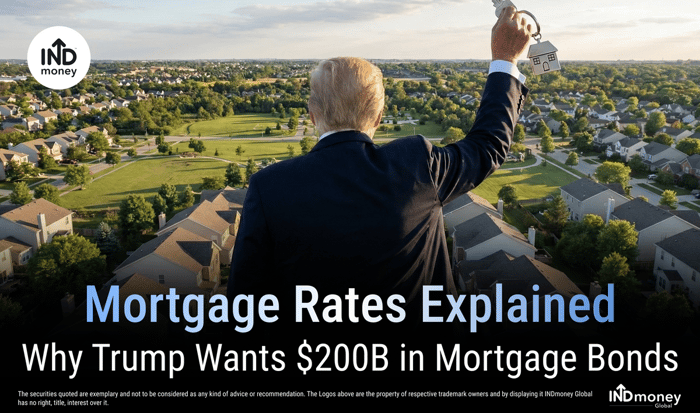
It’s early January 2026, and the housing market is buzzing with one of the most talked-about moves in recent US economic policy. President Donald Trump has announced a plan to have the government buy a whopping $200 billion in mortgage bonds. The headline alone stirred markets, sent mortgage-related stocks surging, and thrust the nitty-gritty of mortgage rates into everyday conversations.
At its core, this is a story about how home loans get priced, why millions of Americans struggle with housing costs, and how policymakers are trying to tip the scales. But to understand what’s going on, we must start with the basics.
Let’s break down with this blog what mortgage rates are, what mortgage bonds mean, why Trump wants this huge purchase, what he’s hoping it will achieve, and what you should watch as this unfolds.
What Are Mortgage Rates?
In simple terms, a mortgage rate is the interest you pay when you borrow money to buy a home. It’s the price of credit for your house loan and determines how expensive your monthly payments will be over the life of the loan.
Think of mortgage rates like the “rent” you pay for borrowing money. When you take a home loan, you are renting a large sum from a bank for 20 or 30 years. If the rent is cheap, you can afford a bigger house for the same monthly payment. If the rent is expensive, even a modest home becomes costly. Mortgage rates are simply the price tag on that rented money, and even small changes in that price can shift monthly EMIs by thousands of dollars over time.
It’s early January 2026, and the average 30-year mortgage rate in the US is hovering around just above 6%, far higher than the sub-3% levels seen during the pandemic, but lower than the near-7% peaks of 2025.
Yet even with slight declines, these rates make monthly payments burdensome for many buyers, especially first-timers or those in expensive markets.
What Are Mortgage Bonds?
Mortgage bonds are a type of mortgage-backed security (MBS), a financial instrument created in the secondary mortgage market. In this market, lenders sell packages of home loans to investors as bonds so they can free up funds to make more loans. Investors in these bonds receive payments that come from the principal and interest on the underlying mortgages.
Think of it this way: banks make loans, then bundle and sell them as bonds. That process helps keep money flowing in the housing market, allowing lenders to keep offering new mortgages.
When demand for these mortgage bonds increases, their prices rise and the yields (or returns) on them fall. Because mortgage rates for borrowers are tied to these yields, stronger demand can help push down borrowing costs.
Why Trump Is Pushing for $200 Billion in Mortgage Bonds
On January 8, 2026, Trump announced via social media that he was directing government entities, specifically the government-sponsored enterprises Fannie Mae and Freddie Mac, to buy $200 billion in mortgage bonds. He said this would help reduce mortgage rates and make homeownership more affordable as voters feel pinched by high housing costs.
These entities currently hold large portfolios of mortgage bonds and have significant cash reserves. Trump believes using part of these reserves for a large bond purchase will increase demand for mortgage bonds, thereby raising their prices and lowering their yields. In theory, lower yields should help lenders offer lower mortgage rates.
This kind of intervention is reminiscent of actions taken by the Federal Reserve during economic stress, such as during the pandemic when the Fed bought massive amounts of MBS to calm markets and bring down rates.
The goal behind Trump’s plan is straightforward: by creating big demand for mortgage bonds, he hopes mortgage rates will move lower, making monthly home loan payments smaller and homeownership more attainable for more Americans.
What Is the Outcome Trump Is Aiming For?
Trump’s message is clear: lower mortgage rates, lower monthly payments, and improved affordability. He has framed this as a response to voter concerns about housing costs amid high inflation and stagnant wage growth.
Financial markets reacted positively. Mortgage-related stocks saw gains following the announcement, indicating investors think lower rates or easier credit could boost the housing industry.
Lower mortgage rates theoretically stimulate more home buying, refinancing activity, and could ease price pressures by expanding the pool of potential buyers. That’s the outcome Trump supporters want.
What to Look Out For
Even if the plan works as envisioned, its impact may be more modest than the headlines suggest. Analysts and economists warn that $200 billion is a large amount in headline terms but relatively small compared to the overall mortgage bond market, which runs into trillions of dollars. As a result, any rate change might be measured in basis points (fractions of a percent) rather than full percentage points.
Also notable is that mortgage rates are only one part of housing affordability. Supply constraints, home prices, taxes and insurance costs also matter, and lowering mortgage rates alone won’t solve structural housing shortages.
Another factor to watch is how quickly lenders pass lower bond yields into actual mortgage pricing. Lenders must manage risk, credit profiles, and profit margins, which means savings on paper don’t always translate immediately into lower consumer rates.
Bottom Line
Mortgage bonds and mortgage rates are deeply connected through the secondary market and investor demand. Trump’s $200 billion mortgage bond push is an effort to tap that connection to ease borrowing costs for homebuyers. While the strategy may provide some relief, its actual impact will depend on market execution, lender behavior, and broader housing market conditions.
For anyone tracking home loan affordability in 2026, this is a story that blends economics, policy, and real-world financial decisions that affect millions of Americans. Keep an eye on actual rate movements, housing inventory trends, and how lenders respond as the year unfolds.
Disclaimer:
The content is meant for education and general information purposes only. Investments in the securities market are subject to market risks, read all the related documents carefully before investing. Past performance is not indicative of future returns. The securities quoted are exemplary and are not a recommendation. This in no way is to be construed as financial advice or a recommendation to invest in any specific stock or financial instrument. Readers are encouraged to verify the exact numbers and financial data from official sources such as company filings, earnings reports, and financial news platforms and to conduct their own research, and consult with a registered financial advisor before making any investment decisions. All disputes in relation to the content would not have access to an exchange investor redressal forum or arbitration mechanism. INDmoney Global (IFSC) Private Limited,Registered office address: Office No. 507, 5th Floor, Pragya II, Block 15-C1, Zone-1, Road No. 11, Processing Area, GIFT SEZ, GIFT City, Gandhinagar – 382355.