

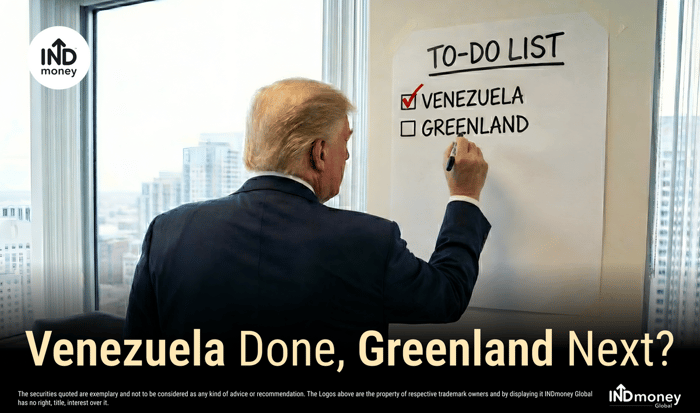
- What Trump Said About Greenland: The Dealmaker Meets the Ice Sheet
- Why Greenland? Follow the Ice… and What’s Under It
- How Greenland Responded: Sovereignty, Served Cold
- Venezuela: Oil, Power, and a Very Old Playbook
- Trump’s “3-Phase Plan”: Strategy or Storytelling?
- Geopolitics Has a Ticker Symbol: Implications for U.S. Markets
- The Bigger Picture: Manifest Destiny, now With Glaciers
History rarely repeats itself cleanly, but it does have a mischievous habit of remixing old ideas in new packaging. In the 19th century, the United States chased Manifest Destiny across the continent. In the 20th, it bought Alaska from Russia in what critics once mocked as “Seward’s Folly.” In the 21st, the script feels familiar again, except this time the frontier is frozen solid.
After dramatic developments in Venezuela and renewed remarks from Donald Trump about Greenland, global attention has shifted north. Very north. The Arctic kind of north. The result is a geopolitical storyline that reads part history book, part strategy memo, and part late-night satire.
What Trump Said About Greenland: The Dealmaker Meets the Ice Sheet
Trump’s position on Greenland has always been blunt: the island is strategically vital, and the U.S. should have more control over it. He has framed this as a national security necessity rather than a colonial impulse, arguing that Arctic defence, missile warning systems, and geopolitical rivals make Greenland too important to ignore.
The language matters. Trump has never spoken about Greenland as a cultural homeland or a sovereign society. He speaks about it the way generals talk about aircraft carriers: fixed, expensive, and impossible to replace. In that framing, Greenland is not a place. It is a platform.
Why Greenland? Follow the Ice… and What’s Under It
If Venezuela is about what flows out of the ground, Greenland is about what the future might unlock. With a population of just 57,000, the island carries disproportionate strategic weight for the U.S. and its allies.
Why Greenland matters
- Geography: Through Denmark’s NATO membership, Greenland sits on the shortest air route between Europe and North America, making it critical to U.S. military planning.
- Early-warning defence: Its location underpins America’s ballistic missile early-warning system, where seconds of advance notice matter.
- Arctic access: Greenland lies at the junction of Arctic airspace, North Atlantic shipping lanes, and future trade routes as ice retreats.
- Military presence: The U.S. already operates Pituffik Space Base, its northernmost installation for missile detection and space surveillance.
- Resources: The island has long been viewed as a potential source of critical minerals and rare earth elements.
In an age of de-risked and “friend-shored” supply chains, securing strategic resources from an aligned territory is a powerful draw. Simply put, oil made Venezuela valuable yesterday. Ice, minerals, and geography make Greenland valuable tomorrow.
How Greenland Responded: Sovereignty, Served Cold
Greenland’s response has been firm and refreshingly unambiguous. Its leadership has rejected any suggestion of acquisition or coercion, emphasising that Greenland is not for sale and never has been.
Denmark, which retains authority over defence and foreign policy, has backed this stance strongly. European leaders have echoed the same message: sovereignty is not a negotiating chip, even when wrapped in security language.
Historically, small territories have learned that when big powers talk about “strategic necessity,” the safest reply is clarity. Greenland has chosen clarity.
Venezuela: Oil, Power, and a Very Old Playbook
Venezuela has some of the largest proven oil reserves in the world, a fact that has shaped its destiny for decades. From Cold War interventions to modern sanctions, energy-rich states have often found themselves at the centre of great-power competition. Oil does not just fuel cars. It fuels leverage.
The U.S. action in Venezuela fits into a long historical pattern where strategic resources, political instability, and global power projection intersect. From Iran in the 1950s to Iraq in the 2000s, the logic has been consistent even when the outcomes have not.
Trump’s “3-Phase Plan”: Strategy or Storytelling?
The Greenland debate has crystallized around a narrative that blends policy signals with speculation, making it difficult to separate strategy from storytelling.
- The “three-phase plan” idea stems from media coverage and analysis rather than any official blueprint.
- It is commonly framed as economic influence first, political pressure next, and strategic control as the end goal.
- Whether formal or not, the perception that the U.S. is pursuing long-term Arctic dominance is what truly matters.
- In geopolitics, perceived intent often moves faster and carries more weight than declared policy.
Geopolitics Has a Ticker Symbol: Implications for U.S. Markets
These developments do not stop at foreign policy briefings; they feed directly into market expectations, where geopolitics is rapidly priced as both risk and opportunity.
- Energy markets track Venezuela closely, as supply disruptions, sanctions, or policy shifts can alter global pricing expectations.
- Defence and aerospace sectors focus on Greenland, where Arctic prioritisation often leads to higher spending on surveillance, missile defence, and space systems.
- Critical minerals narratives shape long-term capital allocation more than short-term US Stock Market moves.
- Persistent geopolitical uncertainty prompts investors to reprice risk, even in the absence of immediate policy action.
The Bigger Picture: Manifest Destiny, now With Glaciers
Seen through a historical lens, this moment feels less shocking. The U.S. has always expanded its strategic perimeter when technology, trade, or security demanded it. What has changed is the terrain. Horses became railroads. Railroads became oil tankers. Oil tankers are now giving way to satellites and icebreakers.
Venezuela represents the old geopolitics of barrels and pipelines. Greenland represents the new geopolitics of data, defence, and the melting map of the Arctic. Whether Greenland ever becomes more than a headline remains to be seen.
But one thing is clear: when history calls, it rarely uses a new script. It just changes the setting.
Disclaimer:
The content is meant for education and general information purposes only. Investments in the securities market are subject to market risks, read all the related documents carefully before investing. Past performance is not indicative of future returns. The securities quoted are exemplary and are not a recommendation. This in no way is to be construed as financial advice or a recommendation to invest in any specific stock or financial instrument. Readers are encouraged to verify the exact numbers and financial data from official sources such as company filings, earnings reports, and financial news platforms and to conduct their own research, and consult with a registered financial advisor before making any investment decisions. All disputes in relation to the content would not have access to an exchange investor redressal forum or arbitration mechanism. INDmoney Global (IFSC) Private Limited, Registered office address: Office No. 507, 5th Floor, Pragya II, Block 15-C1, Zone-1, Road No. 11, Processing Area, GIFT SEZ, GIFT City, Gandhinagar – 382355.