

- Why Warren Buffett Is Worried About the US Dollar
- What Is Dollar Debasement? A Simple Explanation
- Why Governments Choose Debasement Over Default
- Why This Eventually Affects Ordinary Investors
- What the Dollar Index (DXY) Signals About the American Dollar
- How Dollar Debasement Affects Indians Investing in US Stocks
- Why All US Stocks Are Not Equal in a Weak-Dollar World
- So… Is the US Dollar Really Losing Its Value?
For decades, the US dollar has been the anchor of global finance. Commodities are priced in dollars, trade settles in dollars, and central banks stockpile dollars as reserves. Indian investors believed that investing in US stocks meant automatic safety. Strong companies, global dominance, and the world’s most powerful currency. But what if the US dollar itself is quietly losing value?
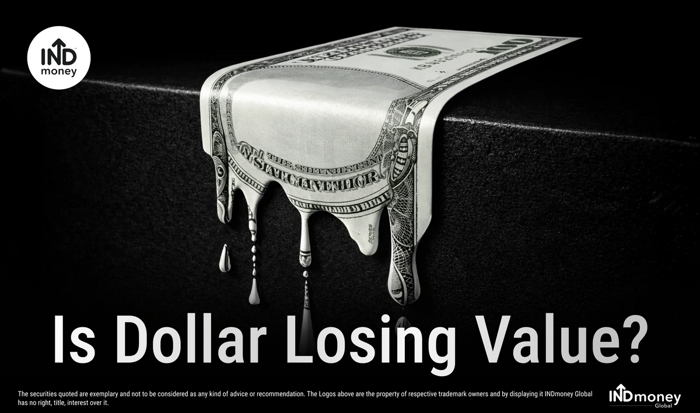
When Warren Buffett began signaling discomfort with the American dollar and backed it up through his recent allocations, it reignited an uncomfortable debate around dollar debasement. Not about collapse, but about dilution. And for people investing in US stocks from India, that distinction could make all the difference between strong returns on paper and weaker returns in reality.
The real question is no longer whether the dollar remains dominant, but whether the US dollar rate can hold its purchasing power over time.
Why Warren Buffett Is Worried About the US Dollar
Warren Buffett’s blunt assessment, calling the dollar “going to hell” and openly stating that he would short it under the right circumstances, raised eyebrows across Wall Street. The ace investor billionaire rarely comments on currencies directly. That is why his actions matter more than his words.
His positioning over the past few months reflects concern about dilution, not collapse. This distinction is critical. A falling US dollar value does not mean the end of the dollar system. It means gradual erosion through policy choices, rising debt, and monetary expansion.
What Is Dollar Debasement? A Simple Explanation
To understand dollar debasement, imagine India has a king who issues gold coins as money.
1. The setup: You own 100 coins. Each coin is made of 100% pure gold. One coin buys you a bag of rice. The king also owes a neighbouring kingdom 1,000 gold coins.
2. The debasement: The king runs out of money. Instead of raising taxes or admitting failure, he quietly melts the coins and mixes in 50% copper. He mints them again so they look exactly the same.
On paper, nothing changes. You still have 100 coins. In reality, each coin now contains only half the gold. The currency has been debased.
3. The result: When you go to the market, merchants quickly realise the coins are diluted. They now demand two coins for the same bag of rice. Your wealth, measured in coins, has not changed. But your purchasing power has been cut in half.
4. The debt incentive: This is where the king benefits. He still owes the neighbouring kingdom “1,000 coins.” By repaying them with the newly diluted coins, he settles his debt using far less real gold than he originally borrowed, without ever defaulting.
This is exactly how dollar debasement works. The US government does not openly default on its debts. Instead, it increases the supply of dollars.
Why Governments Choose Debasement Over Default
The incentive becomes obvious when debt enters the picture. If a government has borrowed heavily and struggles to repay, reducing the real value of money becomes the least visible solution. No default. No renegotiation. Just a quieter reduction in the burden of repayment.
The US is uniquely positioned here. It has borrowed massively from the world in dollars, and it controls the issuance of the US dollar. By expanding the money supply faster than real economic growth, the value of the dollar slowly declines.
Why This Eventually Affects Ordinary Investors
At first, debasement does not feel painful. Wages rise. Asset prices rise. Nominal returns look fine. Over time, however, savings and fixed-income investments lose purchasing power.
Most investors are exposed to government debt directly or indirectly through pensions, retirement funds, or provident funds. As the US dollar value erodes, so does the real value of these claims.
This is why Warren Buffett has long warned that inflation and currency dilution are more dangerous than volatility.
What the Dollar Index (DXY) Signals About the American Dollar
The dollar index, also known as the US Dollar Index (DXY), tracks the dollar against a basket of major global currencies. Movements in the US dollar index reflect changes in global confidence toward the American dollar.
Recent weakness in the dollar index suggests that concerns around fiscal stress, high interest costs, and rising debt are already being priced in. As older bonds mature and refinancing happens at higher rates, pressure on the system increases.
Higher deficits often lead to more money creation, reinforcing the debasement cycle.
How Dollar Debasement Affects Indians Investing in US Stocks
For people investing in US Stocks from India, this discussion is especially important. Returns from US stocks have two components:
- Stock performance
- USD-INR movement
Historically, Indian investors benefited from a rising dollar rate and strong US equity returns. But if the US dollar rate today weakens over time, a part of your equity gains may get diluted when converted back to rupees. US investing does not become unattractive, but currency risk becomes real.
Why All US Stocks Are Not Equal in a Weak-Dollar World
Not every company reacts the same way to a falling US dollar value. Businesses with global revenues, strong pricing power, or exposure to real assets tend to handle debasement better. Companies dependent on fixed domestic pricing or long-term nominal cash flows are more vulnerable. For Indian investors, this means moving beyond passive dollar exposure and focusing on business quality.
So… Is the US Dollar Really Losing Its Value?
The debate around de-dollarisation often sounds dramatic, but reality is slower and more subtle. The dollar does not disappear. Its influence gradually weakens as alternatives grow and confidence shifts. Buffett’s discomfort reflects this slow transition, not an overnight collapse.
The conversation is not about the end of the dollar. It is about the future value of the dollar. The US dollar rate, the dollar index, and long-term policy choices all point toward a world where holding currency itself carries risk.
Disclaimer:
The content is meant for education and general information purposes only. Investments in the securities market are subject to market risks, read all the related documents carefully before investing. Past performance is not indicative of future returns. The securities quoted are exemplary and are not a recommendation. This in no way is to be construed as financial advice or a recommendation to invest in any specific stock or financial instrument. Readers are encouraged to verify the exact numbers and financial data from official sources such as company filings, earnings reports, and financial news platforms and to conduct their own research, and consult with a registered financial advisor before making any investment decisions. All disputes in relation to the content would not have access to an exchange investor redressal forum or arbitration mechanism. INDmoney Global (IFSC) Private Limited, Registered office address: Office No. 507, 5th Floor, Pragya II, Block 15-C1, Zone-1, Road No. 11, Processing Area, GIFT SEZ, GIFT City, Gandhinagar – 382355.