

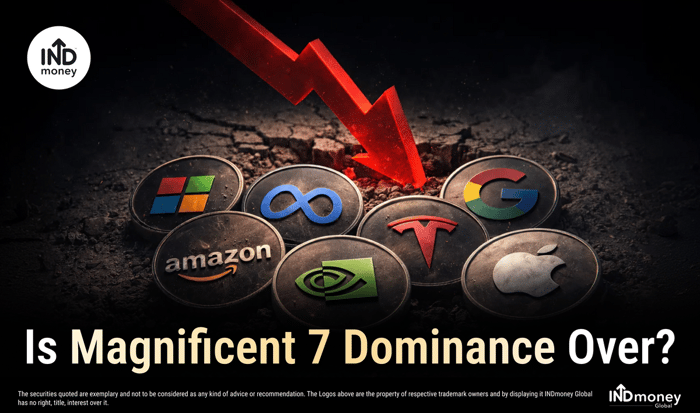
- When Mag 7 Magic Stopped Being Effortless
- Big Tech Earnings: The Great Equaliser
- Mag 7 Valuations: No Longer Nosebleed, Still Demanding
- Seven Tech Giants, Seven Very Different Battles
- So… Is Mag 7 Outperformance Over?
For a while, US markets felt like a cheat code. If your portfolio held the Magnificent 7, you did not need clever timing, sector rotation, or even much conviction. You just needed patience. Big Tech carried the market on its back, shrugged off rate hikes, and turned every dip into a buying opportunity.
But markets have a habit of changing the rules just when investors get comfortable. As 2026 begins, the Magnificent 7 stocks no longer look like a rising tide that lifts all boats. Instead, they look more like a crowded highway, where some lanes are still moving fast and others are stuck in traffic.
Let’s break down with this blog why the Mag 7 trade is losing its “set it and forget it” charm, what is actually driving returns now, and why stock selection inside Big Tech suddenly matters again.
When Mag 7 Magic Stopped Being Effortless
At first glance, nothing seems broken. In 2025, the Bloomberg Magnificent 7 Index comfortably beat the S&P 500. But here’s the catch. Most of that outperformance came from just two names: Nvidia and Google parent Alphabet. Take them out, and the rest of the group struggled to keep pace with the broader market.
For the first time since the US Fed began raising rates in 2022, buying the entire Mag 7 basket actually diluted returns. For investors today, the Mag 7 is no longer one trade. It’s seven very different businesses with seven different profit engines.
If you buy them as a bundle, the laggards can quietly eat up the leaders’ gains. Early 2026 has only reinforced this message. Bloomberg’s Mag 7 index is barely up, while the S&P 500 has quietly pulled ahead. The market is no longer rewarding size alone.
Big Tech Earnings: The Great Equaliser
For the last few years, The Magnificent 7 got rewarded for delivering explosive profit growth and promise: AI potential, platform dominance, future monetisation. In 2026, the vibe is changing and this edge is fading. Investors still believe in AI, but they’re increasingly demanding receipts.
According to Bloomberg, Mag 7 profits are expected to grow about 18% in 2026. That is the slowest pace since 2022 and only modestly better than the roughly 13% growth expected from the other 493 companies in the S&P 500.
This is where the mood shift comes from. When Big Tech was growing twice as fast as the rest of the market, investors happily paid a premium. Now that the gap is narrowing, capital is starting to wander into banks, industrials, energy, and healthcare.
Tech is still important, but it is no longer the only show in town. That’s why you’re hearing more about “market broadening” and less about “only Big Tech works.” UBS has explicitly pointed to that broadening trend continuing.
Mag 7 Valuations: No Longer Nosebleed, Still Demanding
First Trust’s 2025 recap notes the Magnificent 7 carried a combined 33% weight in the S&P 500 during 2025, yet accounted for 42.5% of the index’s total return. That’s dominance, no doubt. But it also marked the first time since 2021 that the group contributed less than half of annual returns.
Translation: the “top-heavy market” problem hasn’t disappeared. But the US market is finally letting other stocks breathe. Valuations tell a similar story. The Magnificent 7 index trades around 29 times forward earnings. That is a far cry from the 40-plus multiples seen earlier in the decade, but it is still rich.
By comparison, the S&P 500 trades near 22 times, while the Nasdaq 100 sits closer to 25 times. Big Tech is no longer priced for perfection, but it still needs to execute cleanly. There is less room for missed quarters or vague promises about future AI payoffs.
Seven Tech Giants, Seven Very Different Battles
Lumping these tech companies together in 2026 is like judging a football team by the jersey, not the players.
- Nvidia: It is still the heartbeat of the AI boom. Competition from Advanced Micro Devices (AMD) is rising, and customers are designing their own chips, but demand continues to outstrip supply. Wall Street remains overwhelmingly bullish.
- Microsoft is playing the long game. Nearly $100 billion a year in AI-related spending is lifting cloud revenues, but investors want proof that AI features can meaningfully boost margins, not just workloads.
- Apple zigged while others zagged. By avoiding aggressive AI spending, it became an “anti-AI risk” trade. Strong iPhone demand helped, but at over 30 times earnings, Apple needs growth to reaccelerate.
- Alphabet has staged a quiet comeback. Gemini’s strong reception and dominance across search, advertising, and AI infrastructure have rebuilt confidence. The challenge is scale. At nearly $4 trillion in market value, even good news has to work harder.
- Amazon could be the dark horse going forward. AWS growth has picked up, and automation in warehouses is starting to lift efficiency. If margins expand as expected, Amazon could surprise.
- Meta Platforms shows how quickly sentiment can turn. Massive AI spending was celebrated, until it wasn’t. Now investors want clear evidence that those billions translate into profits.
- Tesla remains the wildcard. A pivot toward self-driving and robotics has revived growth hopes, but valuations near 200 times earnings leave very little margin for error.
So… Is Mag 7 Outperformance Over?
The blunt answer: the automatic outperformance might be.
The smarter answer: the Mag 7 era is moving from “buy the whole shelf” to “choose the right bottles.” Looks like the market will reward those whose earnings deliver, efficiency gains show up in margins and will keep punishing anyone where AI spending looks like a blank cheque.
Disclaimer:
The content is meant for education and general information purposes only. Investments in the securities market are subject to market risks, read all the related documents carefully before investing. Past performance is not indicative of future returns. The securities quoted are exemplary and are not a recommendation. This in no way is to be construed as financial advice or a recommendation to invest in any specific stock or financial instrument. Readers are encouraged to verify the exact numbers and financial data from official sources such as company filings, earnings reports, and financial news platforms and to conduct their own research, and consult with a registered financial advisor before making any investment decisions. All disputes in relation to the content would not have access to an exchange investor redressal forum or arbitration mechanism. INDmoney Global (IFSC) Private Limited, Registered office address: Office No. 507, 5th Floor, Pragya II, Block 15-C1, Zone-1, Road No. 11, Processing Area, GIFT SEZ, GIFT City, Gandhinagar – 382355.